

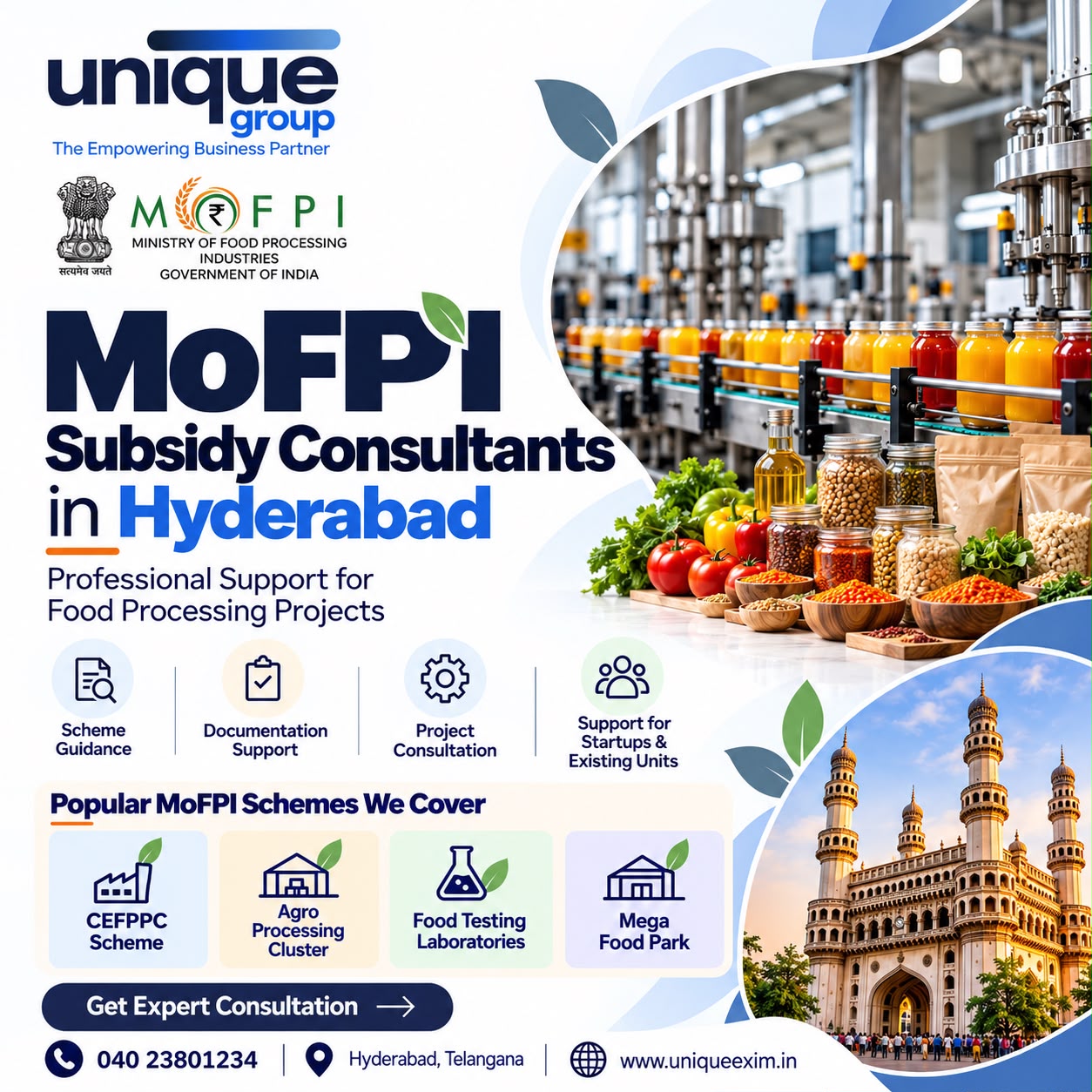
MoFPI Subsidy Consultants in Hyderabad for Food Processing Projects
India's food processing sector is expanding across areas such as food manufacturing, preservation, cold-chain infrastructure, agro-processing, value addition, food testing and export-oriented food products.
For entrepreneurs planning a new food processing unit or expanding an existing facility, Ministry of Food Processing Industries (MoFPI) schemes can provide financial assistance for eligible projects and activities.
However, there is no single "MoFPI subsidy" applicable to every food processing business.
The assistance available depends on factors such as:
- Nature of the food processing activity
- Project size
- Applicant constitution
- Location of the project
- Eligible project cost
- Proposed machinery and infrastructure
- Product category
- Existing or proposed unit
- Applicable scheme guidelines
- Expression of Interest (EOI) or application window
This makes scheme selection and project structuring an important part of the subsidy application process.
Businesses in Hyderabad, Telangana planning to establish, modernize or expand a food processing project can benefit from professional assistance in identifying the relevant scheme, assessing eligibility, preparing project documentation and navigating the application process.
Unique Group provides consultancy support for MoFPI schemes, including scheme identification, eligibility assessment, project report support, documentation and application assistance.
What Is MoFPI?
MoFPI stands for the Ministry of Food Processing Industries, Government of India.
The Ministry's role includes supporting the development of India's food processing sector through measures aimed at reducing wastage of perishable agricultural produce, increasing value addition, encouraging commercialization of agriculture, creating employment and supporting the export of processed and agro-based food products.
For businesses, MoFPI support can be relevant to different stages of the food value chain, including:
- Food processing
- Food preservation
- Cold-chain infrastructure
- Storage
- Agro-processing
- Food safety and testing
- Common processing infrastructure
- Research and development
- Branding and marketing
- Capacity building
The important point for an entrepreneur is that each scheme has its own eligibility criteria, eligible costs and assistance pattern.
Therefore, the first step should not be "How much subsidy can I get?"
It should be:
Which MoFPI scheme is applicable to my project, and which components of my project are eligible?
Major MoFPI Schemes Relevant to Food Processing Businesses
The major schemes of MoFPI include:
- Pradhan Mantri Kisan SAMPADA Yojana (PMKSY)
- Pradhan Mantri Formalisation of Micro Food Processing Enterprises (PMFME)
- Production Linked Incentive Scheme for Food Processing Industry (PLISFPI)
Each addresses a different type and scale of requirement.
1. PM Kisan SAMPADA Yojana (PMKSY)
The Pradhan Mantri Kisan SAMPADA Yojana (PMKSY) is an umbrella programme supporting food-processing infrastructure and value-chain development.
The MoFPI introduced following schemes under PMKSY:
- Integrated Cold Chain and Value Addition Infrastructure
- Creation/Expansion of Food Processing & Preservation Capacities (CEFPPC)
- Infrastructure for Agro-Processing Clusters (APC)
- Operation Greens
- Food Safety and Quality Assurance – Food Testing Laboratories
- Human Resources & Institutions – Research & Development
PMKSY Subsidy / Grant Structure
The MoFPI provides the following assistance for several PMKSY components:
| PMKSY Component | General Areas | Difficult Areas / SC-ST / FPOs / SHGs |
|---|---|---|
| Integrated Cold Chain | 35%, up to ?10 crore | 50%, up to ?10 crore |
| CEFPPC | 35%, up to ?5 crore | 50%, up to ?5 crore |
| Agro-Processing Clusters | 35%, up to ?10 crore | 50%, up to ?10 crore |
| Operation Greens | Up to 35% as specified | Up to 50% as specified |
| Food Testing Laboratories | 50% for eligible private entities | 70% for eligible private entities |
| R&D | 50% of equipment cost for eligible private organisations/institutions | 70% of equipment cost |
These figures are from the MoFPI website and should be read together with the applicable component guidelines and current application/EOI conditions.
PMKSY Has Supported Large Numbers of Projects
The scale of PMKSY implementation highlights the significant investment made in India's food-processing infrastructure.
Up to May 2025, PMKSY recorded:
- 1,604 total projects sanctioned
- ?30,943.43 crore total sanctioned project cost
- ?8,878.40 crore total grant approved
- ?6,380.61 crore total grant released
- 5,02,9461 farmers benefited
- 7,30,236 employment
The above information shows significant project activity under components such as Cold Chain, CEFPPC, Agro-Processing Clusters and Operation Greens.
For an entrepreneur, these figures demonstrate that PMKSY is not simply a theoretical subsidy programme; it has been used for a substantial number of sanctioned food-processing infrastructure projects.
2. PMFME Scheme
The Pradhan Mantri Formalisation of Micro Food Processing Enterprises (PMFME) scheme is focused on micro food-processing enterprises and related groups.
The scheme was designed to provide financial, technical and business support for upgrading micro food-processing enterprises and supporting formalization of the sector.
PMFME Subsidy for Individual Units
For eligible individual and group-category micro food-processing enterprises, the scheme provides:
35% of eligible project cost, subject to a maximum of ?10 lakh per unit.
The scheme also provides for other forms of support.
Common Infrastructure
- Eligible FPOs, SHGs, cooperatives and government agencies can receive:
- 35% credit-linked capital subsidy, subject to a maximum of ?3 crore, for eligible common infrastructure.
SHG Seed Capital
- ?40,000 per SHG member engaged in food processing, subject to the specified scheme conditions and maximum limits.
Branding and Marketing
- The scheme also provides for up to 50% support for branding and marketing for eligible groups such as FPOs, SHGs, cooperatives or an SPV of micro food-processing enterprises.
Who Should Consider PMFME?
PMFME may be relevant for businesses such as micro food-processing enterprises and eligible groups involved in activities including:
- Food manufacturing
- Food processing
- Value addition
- Small-scale processing units
- Group-based food enterprises
- FPO-led processing activities
- SHG-led food processing
However, the exact eligibility must be assessed against the applicable scheme requirements.
3. Production Linked Incentive Scheme for Food Processing Industry (PLISFPI)
The Production Linked Incentive Scheme for Food Processing Industry is different from a conventional capital subsidy.
Its objective is to support food manufacturing entities with specified sales and investment commitments, expand processing capacity and promote Indian food brands in international markets.
The scheme has an outlay of ?10,900 crore for 2021-22 to 2026-27.
The scheme has three broad categories.
Category I
This covers major food product segments including:
- Ready-to-Cook / Ready-to-Eat foods
- Millet-based products
- Processed fruits and vegetables
- Marine products
- Mozzarella cheese
Category II
This relates to innovative/organic products of eligible SMEs, including specified products such as:
- Free-range eggs
- Poultry meat
- Egg products
Category III
This focuses on branding and marketing abroad to support the emergence of Indian food brands in international markets.
How Does PLI Assistance Work?
PLI should not be approached in the same way as a capital subsidy.
Beneficiaries under Category I, Category II and Millet-Based Products need to achieve a minimum year-on-year sales growth of 10% for claiming incentives.
Category I applicants also have committed investment requirements relating to expansion of production capacity.
For Category III branding and marketing support, the document specifies financial incentives of 50% of eligible branding and marketing expenditure abroad, subject to the specified ceiling of 3% of sales or ?50 crore per year, whichever is lower, with minimum expenditure requirements as prescribed.
Therefore, PLI may be more relevant to businesses with the scale, sales, investment and product profile required under the scheme rather than smaller businesses simply looking for capital subsidy.
Which MoFPI Scheme May Apply to Your Project?
Instead of selecting a scheme based only on the advertised subsidy percentage, consider your project characteristics.
| Your Project | Scheme Area to Examine |
|---|---|
| Micro food-processing unit | PMFME |
| Upgrading an eligible micro unit | PMFME |
| Cold-chain project | PMKSY – Cold Chain |
| Food processing/preservation capacity | PMKSY – CEFPPC |
| Agro-processing cluster | PMKSY – APC |
| Eligible post-harvest/value-chain project | PMKSY / relevant component |
| Food testing laboratory | PMKSY – FTL |
| Food-sector R&D project | PMKSY – R&D |
| Large food manufacturing with specified sales/investment | PLISFPI |
| International food branding | PLISFPI – Branding & Marketing |
This table is an initial orientation, not an eligibility determination. The applicable scheme guidelines, applicant profile, project structure and current application window must be examined before proceeding.
Who Can Apply for MoFPI Schemes?
There is no single applicant category applicable to every MoFPI scheme.
Depending on the scheme, eligible applicants may include:
- Individual entrepreneurs
- Proprietorship firms
- Partnership firms
- Private limited companies
- Cooperatives
- Farmer Producer Organizations
- Farmer Producer Companies
- Self-Help Groups
- Government agencies
- Other eligible organizations
Before starting an application, assess:
- What product are you processing?
- Is the unit new or existing?
- What is the proposed investment?
- Where is the project located?
- What is the constitution of the applicant?
- What machinery is being proposed?
- What is the processing capacity?
- What infrastructure is required?
- Which costs are eligible?
- Is the relevant scheme/application window currently open?
Documents Required for MoFPI Subsidy Application
Documentation varies by scheme and applicant.
Common documents may include:
- PAN
- Aadhaar/identity documents
- Company or business registration documents
- GST registration, where applicable
- FSSAI registration/license, where applicable
- Udyam/MSME registration, where applicable
- Bank details
- Land ownership/lease documents
- Detailed Project Report (DPR)
- Machinery quotations
- Project cost estimates
- Financial statements
- Bank loan/sanction documents, where applicable
- Partnership deed or incorporation documents
- Authorization documents
- Technical project documents
The exact documentation should be prepared according to the applicable scheme rather than relying on a generic checklist.
Why the Detailed Project Report Matters
A DPR is not simply a document prepared to satisfy a portal requirement.
For a subsidy-linked food processing project, the project report should logically connect:
Product ? Process ? Capacity ? Machinery ? Investment ? Infrastructure ? Financials ? Eligibility
A good project report should help the reviewing authority understand:
- What the business proposes to manufacture
- Why the project is required
- Production capacity
- Manufacturing process
- Machinery requirement
- Project implementation
- Investment structure
- Financial viability
- Employment potential
- Raw material requirements
- Market opportunity
- Eligible project components
Inconsistent figures between the DPR, machinery quotations, financial statements and application forms can create avoidable queries.
MoFPI Subsidy Application Process
Although the exact process differs by scheme, a typical application journey can involve the following stages:
Step 1: Understand the Project
Define the product, capacity, location, investment and proposed infrastructure.
Step 2: Identify the Applicable Scheme
Assess whether PMKSY, PMFME, PLISFPI or another applicable programme is relevant.
Step 3: Check Eligibility
Review the latest scheme guidelines and applicable conditions.
Step 4: Prepare the DPR
Develop the project report with technical, financial and commercial information.
Step 5: Prepare Supporting Documents
Collect statutory, financial, technical and project-related documents.
Step 6: Submit the Application
Submit through the applicable MoFPI process or portal when the relevant application/EOI window is open.
Step 7: Respond to Queries
Provide clarifications and additional documents if requested.
Step 8: Implement the Project
Execute eligible project activities according to the applicable requirements.
Step 9: Claim / Receive Assistance
Complete the prescribed procedures for claiming or receiving the eligible assistance.
Common Mistakes Businesses Make in MoFPI Applications
A subsidy application can become complicated when the project is not structured around the applicable scheme from the beginning.
Common issues include:
1. Choosing the Scheme Based Only on the Subsidy Percentage
A higher percentage does not necessarily mean that the scheme is suitable for your project.
2. Including Non-Eligible Expenses
Not every project expense necessarily qualifies as eligible project cost.
3. Incorrect Project Cost
The project cost in the DPR, quotations, application and financial documents should be consistent.
4. Weak DPR
A generic project report may not adequately explain the technical and financial structure of the project.
5. Inconsistent Documentation
Differences in company names, investment figures, machinery specifications, addresses or financial data can lead to queries.
6. Inadequate Machinery Quotations
Machinery specifications and quotations should properly support the proposed project.
7. Ignoring Application Windows
Some MoFPI assistance is linked to EOIs or specific application windows.
8. Treating Approval as Automatic
Meeting a basic eligibility condition does not mean that financial assistance is automatically guaranteed.
Why Work With a MoFPI Subsidy Consultant in Hyderabad?
For many food-processing entrepreneurs, the difficult part is not finding the name of a government scheme.
The difficult part is determining:
Does my project actually fit the scheme?
A professional consultant can help examine the project before significant resources are committed to the application.
Typical consultancy support can include:
- Scheme identification
- Eligibility assessment
- Project feasibility guidance
- Eligible-cost analysis
- DPR/project report support
- Documentation assistance
- Machinery quotation review
- Application preparation
- Scheme-specific compliance guidance
- Query and deficiency assistance
- Application follow-up
- Government scheme advisory
How Unique Group Assists Food Processing Businesses
Unique Group provides consultancy and advisory support relating to government schemes, industrial subsidies and associated documentation.
For food-processing projects in Hyderabad, our support can cover the application journey from initial scheme identification to documentation and application assistance.
Our MoFPI Consultancy Services Include:
1. Scheme Identification
Assess the nature and structure of your project to identify the relevant MoFPI scheme or component.
2. Eligibility Assessment
Review the applicant, project, location, investment and other relevant conditions.
3. Project Cost Analysis
Help distinguish eligible project components from costs that may fall outside the applicable assistance structure.
4. DPR / Project Report Support
Assist in preparing project-related documentation required for the application.
5. Documentation Assistance
Organize statutory, financial, technical and project documents.
6. Application Assistance
Support preparation and submission according to the applicable process.
7. Query & Deficiency Assistance
Help prepare responses when additional information or clarification is requested.
8. Scheme Compliance Guidance
Assist businesses in understanding relevant scheme requirements during the project process.
The objective is not simply to submit an application, but to help businesses understand the scheme, eligibility, project structure and documentation requirements before investing significant time and resources.
Frequently Asked Questions About MoFPI Subsidy
Is MoFPI subsidy available for every food processing business?
No. Eligibility depends on the applicable scheme, applicant category, project type, eligible costs and other scheme-specific conditions.
How much subsidy can I get under MoFPI?
There is no single MoFPI subsidy percentage.
For example, the supplied MoFPI material specifies different assistance structures for PMKSY components, while PMFME provides 35% credit-linked capital subsidy for eligible individual micro enterprises subject to the prescribed maximum.
Can an existing food processing unit apply?
Potentially, depending on the scheme and whether the proposed expansion/upgradation satisfies the applicable conditions. Eligibility should be assessed scheme-wise.
Can I include the entire project investment for subsidy?
Not necessarily. Subsidy is generally calculated with reference to the eligible project cost or eligible expenditure specified under the applicable scheme.
Is a DPR required?
A project report/DPR may be required depending on the scheme and project. It is also an important document for explaining the technical and financial structure of the proposed project.
Does applying guarantee subsidy approval?
No. Application, eligibility and approval are separate stages. Financial assistance remains subject to the applicable scheme guidelines, appraisal and prescribed procedures.
Are MoFPI schemes available throughout the year?
Not necessarily. Some assistance is linked to specific application windows or EOIs issued by the Ministry. The current notification should therefore be checked before preparing an application.
MoFPI Subsidy Consultants in Hyderabad
If you are planning a:
- Food processing plant
- Food manufacturing unit
- Cold storage or cold-chain project
- Food preservation facility
- Agro-processing project
- Food testing laboratory
- Processing capacity expansion
- Micro food-processing unit
- Food product branding/export project
the first step is to determine which government scheme is actually applicable to your project.
Unique Group can assist businesses in Hyderabad with:
Scheme Identification ? Eligibility Assessment ? Project Cost Review ? DPR Support ? Documentation ? Application Assistance ? Query Support
Get professional assistance to understand the applicable MoFPI scheme and the requirements for your food-processing project.
Unique Group – The Empowering Business Partner
Website: uniqueexim.in
Phone: 040-23801234
Email: info@uniqueexim.in
Important Note
Because government schemes, application windows, EOIs, eligibility criteria and operational guidelines can change, businesses should verify the latest applicable MoFPI notification and scheme guidelines before submitting an application or committing project expenditure.