The primary objective is to increase the production and availability of standardized Kasturi Cotton Bharat bales by offering an output subsidy of ₹500/bale to Ginning & Pressing factories that upgrade their technology and quality management systems.
x
U
N
I
Q
U
E
G
R
O
U
P


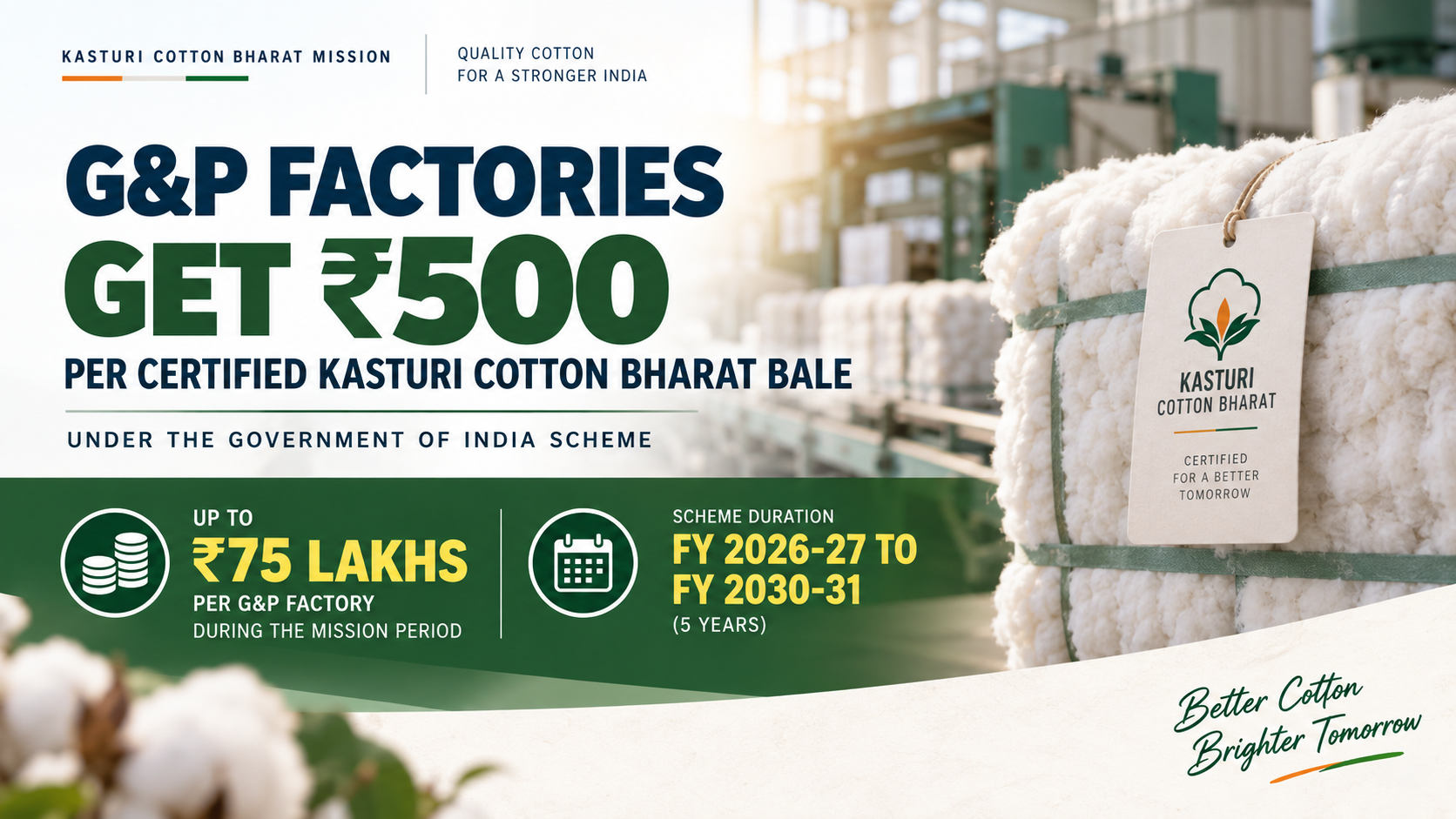
Kapas Kanti Scheme Component 2: Output-Based Support for Ginning & Pressing Factories
The Ministry of Textiles, Government of India, implementing through the Cotton Corporation of India Ltd. (CCI), has launched Component-II under the Mission for Cotton Productivity (Kapas Kanti). This flagship central sector initiative introduces Output-Based Support for Ginning & Pressing (G&P) Factories to boost the global positioning of Indian cotton under the Kasturi Cotton Bharat (KCB) brand.
For modern ginners, this policy offers direct financial support of ₹500 per certified Kasturi Cotton Bharat bale, capped at ₹75 Lakhs per unit across the scheme period. However, accessing this performance-linked subsidy requires strict technical compliance, machinery upgrades, multi-agency certifications, and specific submission timelines.
Why This Scheme Matters
Indian cotton faces significant quality challenges in global markets due to high trash contamination, fiber damage, and varietal mixing. The Kapas Kanti Scheme addresses these structural issues by directly rewarding quality production over raw volume.
- Premium Market Positioning: Establishes Kasturi Cotton Bharat as a global benchmark for softness, strength, and purity.
- Direct Financial Injection: Provides ₹500 per certified bale directly to the G&P unit's bank account via Direct Benefit Transfer (DBT).
- Upgradation Incentive: Encourages units to modernize infrastructure and adopt quality management systems.
- Traceability & Market Access: Integrates producers into an e-Auction and digital traceability portal, enhancing price discovery and buyer confidence.
What is Kapas Kanti Scheme Component 2?
Component-II Sub-Component A(i) is a 100% Centrally Funded Scheme titled “Output-Based Support to Ginning & Pressing Factories”. Operating under an overall outlay of ₹665 Crore for output support (out of the ₹1,000 Crore Component-II budget), the scheme targets the production of 133 lakh certified Kasturi Cotton Bharat bales nationwide.
Key Features
- Scheme Duration: FY 2026-27 to FY 2030-31 (5 Years).
- Incentive Rate: ₹500 per certified Kasturi Cotton Bharat Bale.
- Maximum Ceiling: Up to ₹75 Lakhs per G&P Factory during the mission period.
- Implementing Agency: The Cotton Corporation of India Ltd. (CCI) under the Ministry of Textiles.
Technical Specifications: Kasturi Cotton Bharat Bales
To qualify for certification and the ₹500/bale incentive, produced bales must strictly meet testing parameters set by designated agencies under the Apex Committee:
| Parameters | 28 mm+ | 29 mm+ | 30 mm+ | 31 mm+ | 32 mm+ | 33 mm+ | 34 mm+ | 35 mm+ |
|---|---|---|---|---|---|---|---|---|
| Staple Length / UHML | 28 mm+ | 29 mm+ | 30 mm+ | 31 mm+ | 32 mm+ | 33 mm+ | 34 mm+ | 35 mm+ |
| Micronaire Value | 3.7–4.7 | 3.7–4.5 | 3.7–4.5 | 3.7–4.5 | 3.0–4.2 | 3.0–4.2 | 3.2–4.2 | 3.0–4.0 |
| RD Value (Reflectance) | 76+ | 76+ | 76+ | 76+ | 73+ | 73+ | 74+ | 74+ |
| Fibre Strength (g/tex) | 29.0 (-1.5) | 29.5 (-1.5) | 30.5 (-1.5) | 32.5 (-1.5) | 35.0 (-1.5) | 36.0 (-1.5) | 36.5 (-1.5) | 37.5 (-1.5) |
| Uniformity Index | 83%+ | 83%+ | 84%+ | 84%+ | 83%+ | 83%+ | 85%+ | 85%+ |
| Trash Content | 2% or below | 2% or below | 2% or below | 2% or below | 2% or below | 2% or below | 3% or below | 3% or below |
| Moisture Content | 8% or below | 8% or below | 8% or below | 8% or below | 8% or below | 8% or below | 8% or below | 8% or below |
Mandatory Eligibility Criteria
Ginning & Pressing factories must meet four mandatory criteria to claim output support:
- Portal Registration: Must be actively registered on the official Kasturi Cotton Portal. Registration requires annual renewal.
- Textiles Committee Star Rating: Must hold a minimum 3-Star Rating Certificate issued by the Textiles Committee.
- Mandatory Machinery: Must have an operational Air Jet Lint Cleaner installed on the factory premises.
- Export Promotion Membership: Must hold active membership with TEXPROCIL (The Cotton Textiles Export Promotion Council).
Financial Structure & Application Fees
Availing the scheme involves mandatory initial compliance fees and official charges:
- Kasturi Portal Registration Fee: ₹10,000 + 18% GST (valid for 1 year).
- Textiles Committee Star Rating Fees:
- Application Fee: ₹5,000 + 18% GST.
- First-time Rating Certification Fee: ₹35,000 + 18% GST (valid for 3 years).
- TEXPROCIL Membership: As applicable on the date of registration.
Claim Disbursement Mechanism
Claims submitted in a given month are processed and disbursed via Direct Benefit Transfer (DBT) by the 15th day of the succeeding month. Disbursement is released in a two-tranche structure:
- Tranche 1 (50%): Released immediately upon successful testing and submission of the Kasturi Cotton Bharat (KCB) Bale Certification.
- Tranche 2 (50%): Released after the sale of Kasturi lots upon submission of the Transaction Certificate (TC) issued by the designated agency.
Note: In cases of captive consumption in the ginner’s own spinning mill, a formal Certificate of Consumption is accepted in place of a Transaction Certificate.
Required Documents Checklist
- Legal Identity: Partnership Deed / Memorandum & Articles of Association (MoA/AoA).
- Tax Registrations: GST Registration Certificate & PAN Card.
- Business Identification: UDYAM Registration Certificate for MSME units.
- Industrial Clearances: Valid Factory License.
- Financial & Banking: Bank Account Details & Cancelled Cheque.
- Quality & Technical Certificates:
- Textiles Committee 3-Star (or higher) Rating Certificate.
- Proof of operational Air Jet Lint Cleaner installation.
- Valid TEXPROCIL Membership Certificate.
- Active Kasturi Portal Registration.
- Mandatory TSRS Portal Return Filings (Office of Textile Commissioner).
Compliance Requirements & Common Pitfalls
- Annual renewal of the Kasturi Cotton Portal registration is required.
- Returns must be submitted regularly on the TSRS Portal of the Textile Commissioner Office.
- Testing samples must strictly meet all seven fiber parameters.
Frequently Asked Questions (FAQs)
-
What is the primary objective of Kapas Kanti Scheme Component 2?
-
How much subsidy can a single ginning unit claim under this scheme?
A single unit can claim ₹500 per certified bale, up to a cumulative ceiling of ₹75 Lakhs over the five-year scheme period (FY 2026-27 to FY 2030-31).
-
Is the installation of an Air Jet Lint Cleaner mandatory?
Yes. Installing an operational Air Jet Lint Cleaner is a mandatory prerequisite for availing support under Component 2.
-
What Star Rating is required to participate?
Units must hold at least a 3-Star Rating Certificate from the Textiles Committee.
-
How is the subsidy disbursed to factory accounts?
Disbursement is processed monthly via DBT by the 15th of the following month, split 50% on bale certification and 50% upon submitting the Transaction Certificate or Consumption Certificate.
-
What happens if our factory consumes the produced cotton internally?
For captive consumption, the commercial Transaction Certificate is replaced by a formal Certificate of Consumption to release the remaining 50% disbursement.
-
What is the validity period of the Kasturi Portal Registration?
Portal registration is valid for one year and must be renewed annually.
-
What is the maximum allowable trash content?
Trash content must be 2% or below for staple lengths from 28 mm+ through 33 mm+, and 3% or below for 34 mm+ and 35 mm+ lengths.
-
Who certifies the Kasturi Cotton Bharat bales?
Bales are sampled and certified by agencies appointed by the Apex Committee led by CCI and the Ministry of Textiles.
-
Which export council membership is compulsory?
Active membership with TEXPROCIL (The Cotton Textiles Export Promotion Council) is required.
Why Leading Textile Units Trust Unique Group
Navigating industrial incentives requires deep policy expertise, precise technical execution, and structured agency coordination. As an experienced consulting firm in central and state subsidies, Unique Group serves as a strategic implementation partner for industrial units across India.
- End-to-End Execution: Guidance through Textiles Committee Star Rating audits, TEXPROCIL registrations, and portal onboarding.
- Technical Compliance Review: Audit of machinery standards (Air Jet Lint Cleaners) and fiber quality documentation to minimize claim rejections.
- Disbursement Support: Management of Tranche 1 and Tranche 2 claim filings to maintain steady cash flows.
- Comprehensive Advisory: Combined support across DGFT services, EPCG compliance, GST Refunds, and Ministry of Textiles schemes.
Take the Next Step Toward Your Subsidy
Contact our industrial incentive specialists to review your unit's eligibility and begin your application:
- +91 40-23801234: Telangana – Adilabad, Asifabad/Kumram Bheem Asifabad, Bhadradri Kothagudem, Jangaon, Jayashankar Bhupalapally, Kamareddy, Karimnagar, Khammam, Mancherial, Medak, Mulugu, Nagarkurnool, Nalgonda, Narayanpet, Nirmal, Peddapalli, Rajanna Sircilla, Ranga Reddy, Sangareddy, Siddipet, Suryapet, Vikarabad, Warangal and Yadadri Bhuvanagiri.
- +91 712-2957894: Maharashtra – Ahmednagar, Ahilyanagar, Akola, Amravati, Aurangabad, Beed, Buldhana, Chandrapur, Chhatrapati Sambhaji Nagar, Dhule, Dharangaon, Hingoli, Jalgaon, Jalna, Latur, Nagpur, Nanded, Nandurbar, Parbhani, Wardha and Yavatmal.
- +91 96997 57122: Karnataka – Gulbarga, Hubballi, Kalaburagi, Raichur, Shahapur and Yadgir.
Email: info@uniqueexim.in

Our Unique Services
- Preparation and review of scheme applications and supporting documents.
- Assistance with Textiles Committee Star Rating certification.
- Support for Kasturi Cotton Portal and TEXPROCIL registration.
- Technical compliance review for machinery and fiber quality requirements.
- Preparation and submission of Tranche 1 and Tranche 2 subsidy claims.
- Coordination with implementing and certification agencies.