It is an initiative (G.O.Ms.No.20) aimed at modernizing Andhra Pradesh's poultry sector through capital subsidies for Environmentally Controlled (EC) sheds, meat/egg processing plants, interest subventions, and cold chain development.
x
U
N
I
Q
U
E
G
R
O
U
P


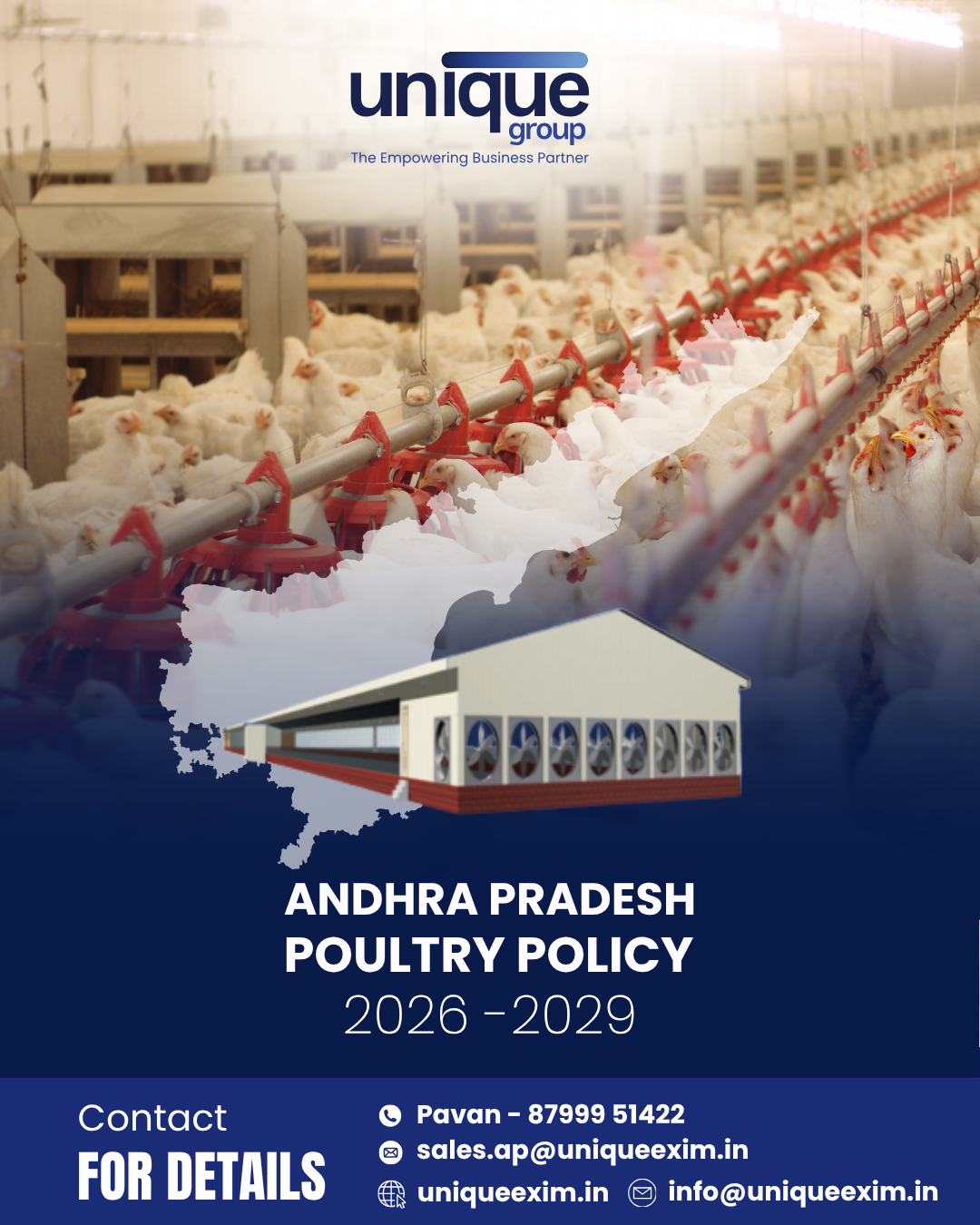
Andhra Pradesh Poultry Development Policy (2026–2029): Complete Scheme, Incentive Structure, and Implementation Guide
The Government of Andhra Pradesh has notified the Poultry Development Policy 2026–2029 (G.O.Ms.No.20, dated 03.09.2026) to modernize the state's livestock infrastructure, promote bio-secure climate-resilient farming, and accelerate meat and egg processing capacity. Contributing over 18% to India's total egg production, Andhra Pradesh continues to expand its leadership in the livestock sector.
The policy introduces a multi-tier incentive structure spanning the Animal Husbandry Department, Industries & Commerce Department (Food Processing Policy 2024-29), and MSME Department. Total budget allocations reach ₹657.18 Crores across key departments.
| Department / Framework | Outlay (₹ in Crs.) | Target Focus |
|---|---|---|
| Animal Husbandry Department | ₹296.00 Cr | EC Sheds, Interest Subvention, NLM Mother Units, ADDLs |
| Food Processing Policy (2024-29) | ₹209.00 Cr | Abattoirs, Processing, Cold Chain, Egg Plants, Waste-to-Value |
| Industrial & MSME Incentive Policy | ₹152.18 Cr | SGST Reimbursement, Power Subsidies, Infrastructure |
| Total Allocation | ₹657.18 Cr | Comprehensive State Poultry Infrastructure |
Navigating eligibility criteria, cluster requirements, and multi-department filings requires strategic planning. Unique Group assists investors, integrators, and processing units in structuring projects to maximize subsidy realization and avoid procedural delays.
Why This Policy Matters for Investors and Farmers
Rising feed ingredient costs, market price volatility, disease threats (such as Avian Influenza), and shifting inter-state trade dynamics demand modern infrastructure. The 2026–2029 policy addresses these challenges through:
- Climate Resilience & Technology Integration: Direct financial support to transition open sheds into Environmentally Controlled (EC) sheds to lower bird mortality and increase Feed Conversion Ratios (FCR).
- Value-Addition Focus: Incentives targeting secondary and tertiary processing (e.g., egg powder, ready-to-cook/eat chicken, canned meats, and pet food) rather than live-bird trading alone.
- Working Capital & Loan Cost Reduction: State interest subvention layered over Central schemes (such as AHIDF and AIF) to reduce net interest overhead.
- Streamlined Clearances: Single Desk Clearance via the state's e-platform for fast-track approvals.
Key Pillars and Objectives of the Scheme
- Production Enhancement: Modernizing commercial layer and broiler farms through technology adoption.
- Processing & Value Addition: Transitioning from wet-market reliance (>95% wet market) to organized, hygienic processing, modern abattoirs, and cold chain logistics.
- Bio-Security & Health Safeguards: Mandatory registration of all poultry farms, quarterly veterinary visits, and bio-security protocols.
- Rural Entrepreneurship: Establishing Mother Poultry Units under the National Livestock Mission (NLM) via SHGs, FPOs, and private entrepreneurs.
Incentives & Subsidy Pattern (2026–2029)
Component I: Environmentally Controlled (EC) Poultry Sheds (AH Dept)
To facilitate climate-resilient, bio-secure farming, ₹48 Crores is allocated specifically for EC sheds.
- New EC Sheds: 25% Capital Subsidy capped at ₹25 Lakhs.
- Existing Shed Upgradation: 25% Capital Subsidy capped at ₹20 Lakhs.
- Interest Subsidy: 5% per annum for up to 2 years on term loans (for interest rates exceeding 7%), capped at ₹5 Lakhs.
- Power Tariff Subsidy: ₹2.00 per unit power subsidy for 3 years from the date of placing the first batch (capped at ₹10 Lakhs per annum).
Component II: Processing, Value Addition & Abattoirs (Food Processing Policy 2024-29)
For New processing units, capital grants depend on enterprise size and processing depth:
| Enterprise Category | Primary Processing Subsidy (Slaughter, Chilling, Cleaning, Egg Shelling) | Secondary/Tertiary Processing Subsidy (Freezing, RTC/RTE, Egg Powder, Canned) | Incentive Disbursement Period |
|---|---|---|---|
| FPOs / SHGs / Cooperatives | 25% FCI (Cap: ₹50 Lakhs) | 35% FCI (Cap: ₹5.00 Crores) | 2 Years |
| Micro Enterprises | 25% FCI (Cap: ₹25 Lakhs) | 35% FCI (Cap: ₹35 Lakhs) | 2 Years |
| Small Enterprises | 25% FCI (Cap: ₹1.50 Crores) | 35% FCI (Cap: ₹3.50 Crores) | 3 Years |
| Medium Enterprises | 25% FCI (Cap: ₹7.00 Crores) | 35% FCI (Cap: ₹8.00 Crores) | 4 Years |
| Large Enterprises | 15% FCI (Cap: ₹25.00 Crores) | 15% FCI (Cap: ₹25.00 Crores) | 5 Years |
Additional Processing Incentives
- Modern Abattoirs, Meat Processing & Animal Feed Units: Up to 35% FCI (Medium capped at ₹15 Cr, Large capped at ₹25 Cr; FPOs up to 50% FCI capped at ₹15 Cr).
- Waste Processing Units (Bio-fuel, Manure, Power): 25%–50% FCI subsidy (Micro: ₹25 L, Small: ₹2.5 Cr, Medium: ₹5 Cr, FPOs: ₹2 Cr).
- Technology Upgradation / Modernization: 20% FCI subsidy (Micro: ₹20 L, Small: ₹1 Cr, Medium: ₹5 Cr).
- NABL Food Testing Labs (Antibiotic Residue Testing): 35% capital subsidy on machinery and civil works up to ₹5.00 Crores.
- Net SGST Reimbursement: 100% Net SGST reimbursement on local sales for 5 to 6 years, capped at 5% of annual turnover.
Component III: Commercial Farm Loans & Central Scheme Top-Ups
- Flat Interest Subvention: Flat 4% interest subvention per annum on Term Loans / Working Capital for all registered commercial poultry farms and state hatcheries for 5 years.
- National Livestock Mission (NLM): 50% capital subsidy up to ₹25 Lakhs for setting up Rural Hatcheries and Mother Units (for Backyard/Desi breeds like Aseel, Vanaraja).
- AHIDF / AIF Top-up: Additional 2% interest subvention for 5 years over Central approvals.
Eligibility Criteria & Mandatory Compliance Norms
Location & Distance Norms (New Poultry Farms)
To protect public health and prevent disease transmission, new farm setups must meet specific buffer distance requirements:
- Residential Zones: Minimum 500 meters away to mitigate odor and fly concerns.
- Water Bodies (Rivers, Lakes, SS Tanks, Canals): Minimum 100 meters away.
- Highways: Minimum 100 meters from National Highways (NH) and 50 meters from State Highways (SH).
- Internal / Rural Roads: Minimum 10–15 meters distance.
- Farm Boundary Clearance: Sheds must maintain a minimum 10-meter buffer from plot boundaries for ventilation.
Mandatory Registration & Bio-Security
- Departmental Enrollment: Every commercial farm, hatchery, egg trader, and packer must register with the AP Animal Husbandry Department.
- Fee Structure: Tiered registration fees based on flock size (from ₹50 for up to 1,000 birds to ₹2,000+ for over 1,00,000 birds; valid for 3 years).
- Penalties for Violation: Improper disposal of dead birds or farm waste attracts penalties: ₹10,000 (first offense), ₹25,000 (second offense), and suspension of operations for repeated non-compliance.
Common Pitfalls and How Experienced Consultants Mitigate Them
- Incorrect Processing Classification: Mistaking primary processing (which receives a 25% subsidy rate) for tertiary processing (which qualifies for up to 35% with higher caps) can lead to reduced funding. Mitigation: We structure product lines and DPRs to reflect higher value-add processes.
- Non-Compliance with Buffer Distances: Acquiring land within 500m of residential clusters or 100m of water bodies leads to immediate rejection during site inspection. Mitigation: We perform pre-acquisition spatial due diligence.
- Capital Cost Benchmarking Discrepancies: Unsubstantiated machinery costs or civil expenditures may be disallowed during audit. Mitigation: We align DPR line items with recognized civil and electromechanical cost standards.
- Delayed Bank Coordination for Subvention: Failing to secure annual loan status certificates leads to missed interest subsidy claims. Mitigation: We manage ongoing bank coordination for annual releases.
Frequently Asked Questions (FAQs)
-
What is the Andhra Pradesh Poultry Development Policy 2026–2029?
-
Who is eligible for capital subsidies under this policy?
Commercial poultry farmers, integrated broiler operators, food processing enterprises, FPOs, SHGs, Cooperatives, and SC/ST entrepreneurs setting up units in AP.
-
How much capital subsidy is available for modernizing poultry sheds to EC sheds?
New EC sheds receive up to 25% capital subsidy capped at ₹25 Lakhs. Upgradations of existing sheds to EC standards qualify for 25% capped at ₹20 Lakhs.
-
What incentives are available for secondary and tertiary egg/poultry processing?
Processing units qualify for up to 35% FCI capital subsidy under the AP Food Processing Policy (Micro: ₹35 L, Small: ₹3.5 Cr, Medium: ₹8 Cr, Large: ₹25 Cr).
-
What are the buffer distance requirements for establishing a new poultry farm?
Farms must maintain a distance of at least 500m from residential zones, 100m from major water bodies and National Highways, 50m from State Highways, and 10m from farm plot boundaries.
-
Is registration with the Animal Husbandry Department mandatory?
Yes, all commercial layer/broiler farms, hatcheries, and egg traders/packers must register with the Divisional Registration Committee.
-
What interest subvention is provided on commercial bank loans?
A flat 4% interest subvention per annum is provided on term loans and working capital for commercial poultry farms. For EC sheds, a 5% interest subsidy is available for 2 years on term loans with interest rates above 7% (capped at ₹5 Lakhs).
-
What is the subsidy for setting up a Mother Poultry Unit under NLM?
Under the National Livestock Mission (NLM), individual entrepreneurs, SHGs, and FPOs setting up Mother Units get a 50% capital subsidy up to ₹25 Lakhs.
-
Are power tariff concessions offered to commercial poultry farms?
Yes, new commercial EC poultry farms receive a power tariff subsidy of ₹2.00 per unit for 3 years (capped at ₹10 Lakhs/year).
-
Can processing units claim SGST reimbursement?
Yes, eligible MSME food processing units receive 100% Net SGST reimbursement for 5 to 6 years (capped at 5% of annual turnover).
-
What financial assistance is available for poultry waste processing and manure management?
Setting up waste processing units (converting manure to bio-fuel/organic manure) qualifies for a 25% to 50% capital subsidy depending on the enterprise size (up to ₹5 Cr for Medium units).
-
How long does it take to process subsidy applications?
Registration certificates are typically issued within 30 days of filing. Capital subsidy approvals by the Empowered Committee usually take 60 to 90 days following bank closure and site verification.
Why Work with Unique Group
Securing capital grants and operating subsidies across multiple government departments requires deep technical expertise, structural planning, and active monitoring.
- Comprehensive Project Structuring: We align your land selection, civil infrastructure, and machinery bills with exact G.O. guidelines to prevent cost disallowances.
- End-to-End Application Management: We prepare complete Bankable Detailed Project Reports (DPRs), manage Single Desk Portal filings, and address technical queries from the Empowered Committee.
- Post-Sanction Disbursement Support: Our engagement continues through physical inspections, tax invoice verifications, and annual SGST and interest subvention releases.
Contact Unique Group's Subsidy Advisory Team to evaluate your project eligibility and structure your incentive roadmap
Contact Unique Group for help with your poultry project.
Contact now Contact now