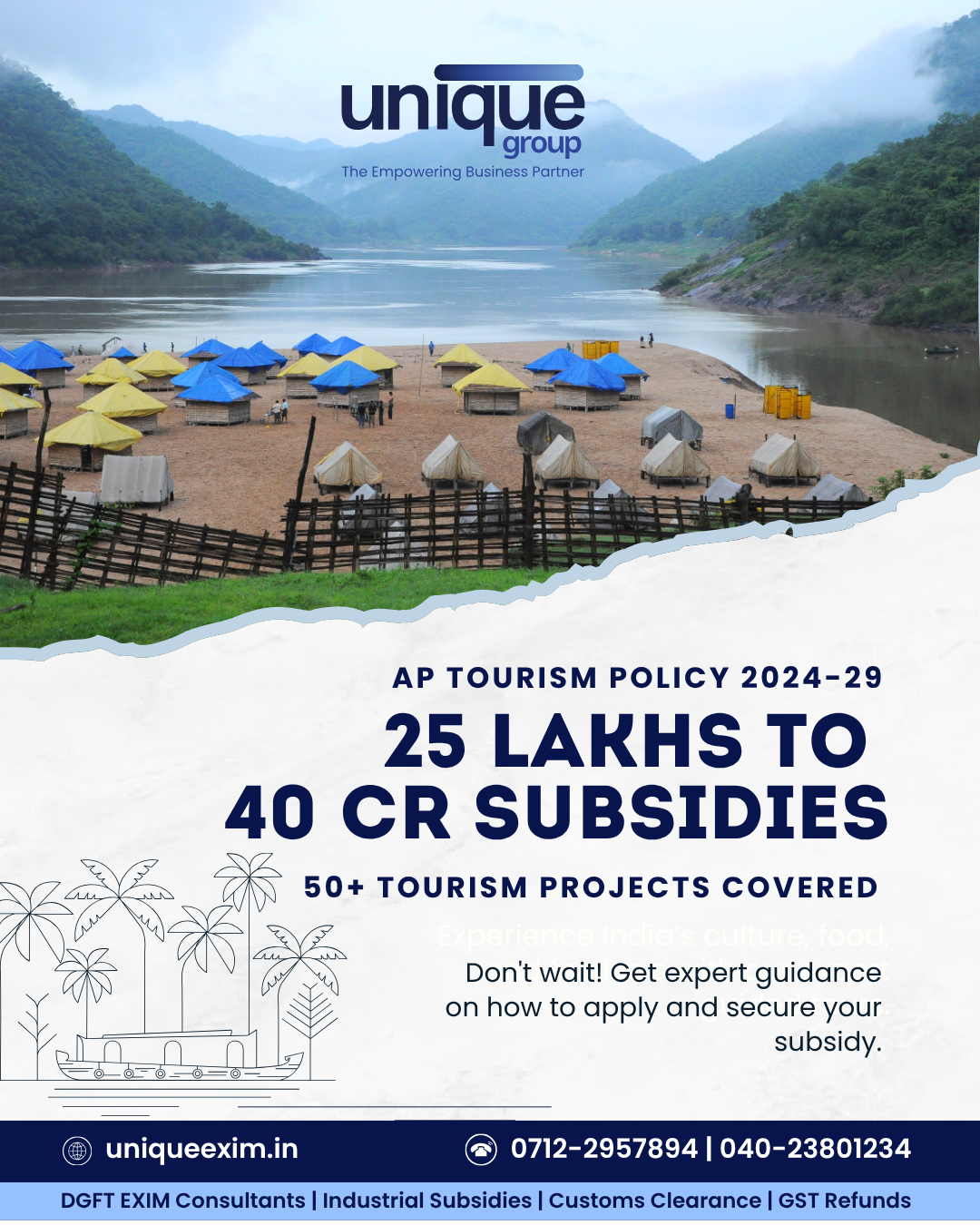
The AP Tourism Policy 2024–29 is a state initiative running from December 10, 2024, to December 9, 2029. It provides capital subsidies, Net SGST refunds, power tariff concessions, and stamp duty reimbursements to private tourism and hospitality investments in Andhra Pradesh.
x
U
N
I
Q
U
E
G
R
O
U
P


AP Tourism Policy 2024–29: Comprehensive Guide to Subsidies, Eligibility, and Implementation
Andhra Pradesh has launched its Tourism Policy 2024–29 (notified under G.O.Ms.No.17 and supported by operational guidelines in G.O.Ms.No.30). As India's third most visited tourist destination, boasting the country's second-longest coastline, Andhra Pradesh offers a comprehensive package of fiscal and non-fiscal incentives to drive private investments across hospitality, adventure, and experiential tourism.
Whether you are developing a 5-star coastal resort, a MICE convention center, an eco-tourism park, or a wellness retreat, navigating state policies requires deep regulatory expertise. Unique Group acts as your end-to-end strategic partner, assisting investors, developers, and MSMEs in structuring project costs, securing statutory approvals, and ensuring complete subsidy disbursement.
Why the AP Tourism Policy 2024–29 Matters for Investors
The Andhra Pradesh Tourism Policy 2024–29 provides substantial financial backing for new projects, expansions, and diversifications. Valid from December 10, 2024, to December 9, 2029, this framework lowers capital expenditure (CAPEX) and operating expenditure (OPEX) by offering:
- Capital Subsidies: Up to 30% of Eligible Fixed Capital Investment (FCI).
- 100% Tax Reimbursements: Full refund of Net SGST for 7 to 15 years.
- OPEX Reductions: Commercial-to-industrial power tariff differential reimbursements.
- Statutory Exemptions: 100% reimbursement of stamp duty, land conversion, and transfer duties.
Classification of Tourism Projects
Under the policy guidelines, projects are categorized based on their total capital investment. This classification determines the subsidy rates, disbursement schedules, and approval authorities:
| Project Classification | Capital Investment (INR) | Standard Investment Period | Approval Body |
|---|---|---|---|
| Micro Tourism Enterprise | Up to ₹1.00 Crore | Within Policy Validity | DIEPC |
| Small Tourism Enterprise | > ₹1.00 Crore to ₹10.00 Crores | Within Policy Validity | DIEPC |
| Medium Tourism Enterprise | > ₹10.00 Crores to ₹50.00 Crores | Within Policy Validity | DIEPC |
| Large Tourism Enterprise | > ₹50.00 Crores to ₹250.00 Crores | 2 Years from CTE | SLC |
| Mega Tourism Project | > ₹250.00 Crores to ₹500.00 Crores | 3 Years from CTE | SLC / SIPB |
| Ultra Mega Tourism Project | > ₹500.00 Crores | 4 Years from CTE | SLC / SIPB |
Note: DIEPC refers to the District Industries and Export Promotion Committee; SLC refers to the State Level Committee on Incentives
Financial Incentives and Subsidy Structure
1. Capital Investment Subsidy
Capital subsidies are calculated on the Eligible Fixed Capital Investment (FCI) and disbursed in equal annual installments.
| Category | Subsidy (as % of eligible (FCI)) | Max. subsidy (INR) | Disbursement period |
|---|---|---|---|
| General Category | |||
| Micro | 25% | 25 Lakh | 2 years |
| Small | 25% | 1.5 Crores | 3 years |
| Medium | 25% | 7.5 Crores | 4 years |
| Large | 10% | 10 Crores | 5 years |
| Mega | 10% | 25 Crores | 5 years |
| Ultra Mega | 10% | 40 Crores | 5 years |
| Special Category (Women, BC, SC, ST, Minorities, Specially-Abled) | |||
| Micro | 30% | 35 Lakh | 2 years |
| Small | 30% | 1.6 Crores | 3 years |
| Medium | 30% | 7.6 Crores | 4 years |
2. Special Incentives Top-Up
- Speed of Doing Business Incentive: Large, Mega, and Ultra Mega units receive an additional 2% subsidy if commercial operations commence within 1 year of the Government Order, or 1% if completed within 2 years.
- Geographic-Spread Incentive: An additional 5% capital subsidy is available for MSME and Large projects established in identified "Known but Unexplored Gems" locations across Andhra Pradesh.
3. Operational & Tax Relief Measures
- 100% Net SGST Reimbursement: 100% refund of Net SGST paid via cash ledger for 7 years (MSMEs) or 7 to 15 years (Large & above), capped at 100% of Eligible FCI.
- Power Cost Reimbursement: Covers the difference between Commercial and Industrial power tariffs levied by DISCOMs, along with a refund of Electricity Duty. Claims are filed on a half-yearly basis.
- Statutory Fee Waivers: 100% reimbursement of Stamp Duty, Transfer Duty, and Land Conversion Charges incurred on land/building purchases or leases for tourism use.
- Quality Certification Reimbursement: 100% cost reimbursement up to ₹2.00 Lakhs for National Certifications and up to ₹10.00 Lakhs for International Quality Certifications.
- Tailor-Made Incentives: Custom incentive packages negotiated through the State Investment Promotion Board (SIPB) for Mega and Ultra Mega investments.
Overall Ceiling: Total combined incentives claimed across all policy heads cannot exceed 100% of the Eligible Fixed Capital Investment (FCI).
Eligible Tourism Projects & Technical Criteria
The AP Tourism Policy 2024–29 covers 49 distinct tourism categories. Below are key segments and their specific eligibility guidelines:
| Sl. No. | Tourism Project | Description | Location |
|---|---|---|---|
| 1 | Heritage Hotel | Classified Heritage hotels as per the guidelines of Ministry of Tourism, Government | Across the State |
| 2 | Hotels | Classified as 3 star and above category Hotels as per guidelines of Ministry of Tourism (MoT) | Across the State |
| 3 | Resorts | Classified as 3 star and above category accommodation with 10+ rooms and at least 4 recreational facilities such as games, pools, or health clubs | Across the State |
| 4 | Time-Sharing Resorts | Classified as 3 star and above category properties with shared ownership and scheduled exclusive usage periods | Across the State |
| 5 | Motel | Accommodation on highways with 10+ rooms, restaurant, and essential amenities and the land cost should not be more than 20% of FCI | Across the State |
| 6 | Budget Hotels | Accommodation with 10+ rooms, restaurant, and essential amenities and the land cost should not be more than 20% of FCI | Across the State |
| 7 | Hospitality Park | Clusters of tourism units over 100 hectares, on private/ government land | Across the State |
| 8 | Mud Cottages | Earth-based structures, offering rustic accommodation. Min. land 0.5 acres and Min rooms /tents/ camps: 03 | Within the focus tourism destination |
| 9 | Log Huts/Cottages | Wooden accommodations harmonized with natural surroundings. Min. land 0.5 acres and Min rooms /tents/ camps: 03 | Within the focus tourism destination |
| 10 | Tourist Villas | Villas with kitchenette, and entertainment facilities. Min. land 0.5 acres and Min rooms /tents/ camps: 03 | Within the focus tourism destination |
| 11 | Tented Accommodation/Glassy Pods | Fixed tents with attached toilets, operational for 90+ days/year for 5 years with a min EFC of INR 1.0 Crore. Min. land 0.5 acres and Min rooms /tents/ camps: 03 | Within the focus tourism destination |
| 12 | Eco tourism- Joint Forest Management Committee (JFMC) | Community-led sustainable forest management for ecotourism, involving conservation and local engagement. | Within the focus tourism destination |
| 13 | Eco tourism- Village Committees | Local bodies managing resources and promoting community-based tourism | Within the focus tourism destination |
| 14 | Eco tourism- Youth Hostel/Youth Clubs | Shared accommodations with 10+ beds, aimed at budget-friendly tourism. | Within the focus tourism destination |
| 15 | Eco tourism- Serviced Apartments | Tourist accommodations with a kitchenette, 3+ apartments, and additional recreational facilities. | Within the focus tourism destination |
| 16 | Beach Shacks | Temporary, ecofriendly seasonal structures for tourists, as per CRZ norms | Within the focus tourism destination |
| 17 | Homestays/ Bed & Breakfast | The Homestay/ B&B establishment shall have a minimum of 1 (one) lettable room (2 beds) and a maximum of 6 (six) lettable rooms (12 beds). The owner of the Homestay establishment along with his/ her family shall be physically residing in the same establishment. The owner/ promoter of the B&B establishment shall not reside at the establishment, but a designated agent/ operator manages the establishment premises for providing the necessary hospitality services to the guests. The Homestay/ B&B establishment shall be free from any dispute. | Within the focus tourism destination |
| 18 | Restaurants | Minimum of 100 covers and Restaurant with kitchen as per classified guidelines offering food, parking, restrooms etc. b) Gourmet and Specialty Restaurants that showcase the local cuisine, Food Markets and Artisanal Shops where tourists can buy local grown products handmade confection. c) Culinary Cruises with onboard cooking classes, themed dinners which reflects state culture and food. | Within the focus tourism destination |
| 19 | Wayside Amenities / Dhabas | Facilities on highways offering food, parking, restrooms, and medical services with land cost not more than 20% of FCI | Within the focus tourism destination |
| 20 | MICE/Convention Centre / Destination wedding | Facilities for events, with 1,000+ seating capacity, parking, and certifications. | Across the State |
| 21 | Theme Park | Specially oriented towards tourism in which land scaping, structures and attractions are based on one or more specific themes such as jungle wildlife and fairytales, mythology etc. with amenities, excluding mallbased projects min 5 acres with Min. EFC INR 10.00 Crore | Across the State |
| 22 | Water Park | Recreational facility with 5+ water sites on 5 acres, handling 100+ slides simultaneously. | Across the State |
| 23 | Amusement Park | Permanent facility with at least 8 amusement rides on 20,000 sqm. area. | Across the State |
| 24 | Arts and Cultural Centre | Facility for artisans, exhibitions, performances, and cultural events, with a minimum exhibition area of 2,500 Sqft | Within the focus tourism destination |
| 25 | Arts and Cultural Centre | State-of-the-Art, AR-VR Zones, 7 D and above Experience, Cultural Centre / Amphitheaters / Theatres / Art Galleries/Viewing Gallery showcasing the art, craft, heritage and culture with a Min EFC of INR 1.00 Crore | Within the focus tourism destination |
| 26 | Arts and Cultural Centre | Light & sound/Laser shows with minimum seating arrangement for 50 | Within the focus tourism destination |
| 27 | Arts and Cultural Centre | GPS guided Audio /video guided services, navigation of the destination in multiple international and Indian languages, based on the need | Within the focus tourism destination |
| 28 | Ropeways/Cable Cars | Eco-friendly transportation with safety measures and tourist facilities. | Within the focus tourism destination |
| 29 | Medical Tourism Units | Facilities offering treatments like yoga, Ayurveda, spas, and wellness services | Within the focus tourism destination |
| 30 | Wellness/Health Farm | Accommodation with 8+ rooms, recreational facilities, and healthfocused activities in pollution-free environments | Within the focus tourism destination |
| 31 | Oceanarium / Aquarium | Unit engaged in display of aquatic life to tourists with minimum investment in Eligible Capital Assets (of oceanarium / aquarium component): INR 10 Crore | Within the focus tourism destination |
| 32 | Golf Course | Golf Course: Minimum 9-hole facility with Min 25 acres. Minimum area of club house: 5,000 Sqft. Minimum number of guest rooms: 2 Minimum facilities: Restaurant, indoor sports and common toilets. | Within the focus tourism destination |
| 33 | Plantation/Farm Tourism Projects/ Botanical Gardens | Minimum land area of Plantation:5 acres Minimum built-up area: 5,000 Sqft. Minimum number of guest rooms: a) Rural Tourism Unit: Accommodation showcasing rural life, art, and heritage, with a minimum of 5 rooms and a reception area. b) Agro Tourism Unit: Accommodation on/near working farms offering tourism experiences like farm tours and activities such as agriculture, horticulture, or dairy farming, with a 5 minimum of lettable rooms. c) Global Tourism Village: Development of destinations with global appeal through infrastructure, culture promotion, and sustainable practices. d) Botanical Gardens: Having a variety of botanically rich plantation, medical herbs, fruits, tea, spices, etc. | Across the State |
| 34 | Museums/ Planetariums | A structure built to conserve and/ or exhibit work of art, science, history, culture and/or heritage in a covered premises. Minimum built-up area: 20,000 Sqft. | Across the State |
| 35 | Adventure Tourism Project | a) Adventure Sports Competition: Events at international, national, or state levels, recognized by competent authorities, as per MoT guidelines b) Adventure Tourism Unit: Projects offering risk-based activities with trained staff, equipment, and safety measures. Categories: (1) Land-Based (e.g., trekking, wildlife safaris), (2) Water-Based (e.g., rafting, kayaking), (3) Air-Based (e.g., hot air ballooning) as per MoT guidelines c) Aero Sports - operators with valid license from MoCA. Approved standard copter all regulatory norms and the pilot must have commercial license d) Glamping and Camping: Organizing Glamping and Camping for a troop of minimum 10 persons e) Stand-up paddleboard (SUP): Organizing SUP activities in backwaters f) Obstacle course races (OCRs): Organizing adventure challenges offering a mix of endurance, strength, and agility tests | Across the State |
| 36 | Sea Cruise Tourism | "Cruise tourism project" shall entail procurement and deployment of cruise vessels and adequate manpower & hospitality services for operations of a domestic cruise service, with: Minimum number of cruise vessels: 1 Minimum capacity of cruise: 350 pax, excluding crew Minimum number of guest rooms in the cruise vessel: 100 Minimum facilities on the cruise vessel: Gym, Swimming Pool, Restaurant, Bar, Open deck vessel should be built as per internationally accepted safety standards. The route for cruise travel shall have both start and end points within the Andhra Pradesh | Within the focus tourism destination |
| 37 | House Boats/ Cruise boats / Yachts. | House Boats with Two /Three / Four Bedroom, Dining Hall, Living area, Kitchen | Within the focus tourism destination |
| 38 | Caravan /Caravan Park | "Caravan Park" designated places where Caravan can be parked and can stay overnight in the designated places providing basic amenities, security measures | Across the State |
| 39 | Seaplane and Heli Tourism | Tourism activities using helicopters for sightseeing and accessing remote areas. | Across the State |
| 40 | In bound tour operators /Travel agents | The approved Tour and Travel Operators working or international inbound tourist operators approved by MoT | Across the State |
| 41 | Souvenir shops | More than 50% of the products sourced from local manufacturers or artisans with min 1000 Sqft. | Within the focus tourism destination |
| 42 | Heritage Walks | Heritage walks are a way to explore the history of a city/town/village | Within the focus tourism destination |
| 43 | New Tourism Start-ups | Innovative ventures offering unique experiences like eco-tourism and techenabled travel solutions | Within the focus tourism destination |
| 44 | Under water Museum | Submerged exhibits blending art, marine life, and conservation | Within the focus tourism destination |
| 45 | Artificial reef and submarine | Marine habitats for diving and snorkelling, with submarines enabling underwater exploration | Within the focus tourism destination |
| 46 | Handloom and Handicraft | Handloom and Handicraft shops/outlets with more than 75% of the products sourced from local manufacturers or artisans with min 1000 Sqft. | Within the focus tourism destination |
| 47 | Hospitality Parks | Development of parks comprising of cluster of tourism & hospitality related units (concept similar to APIIC Industrial Areas) with a minimum of 100 Acres. | Within the focus tourism destination |
| 48 | Urban Tourism | Waterfronts, Ancient Monuments and Statues, Historical Streets which are taken care by Tourism departments | Within the focus tourism destination |
| 49 | Cinematic Tourism | Asset such as Film Studios, Film Cities, Film Exhibition Facilities, Permanent Sets for FilmShooting purposes. Film-Related Conventions where fans can meet actors, watch panels, and participate in activities related to their favorite films and franchises. Busking and street music festivals, Music retreats and workshops | Within the focus tourism destination |
Fixed Capital Investment (FCI) Calculation Guidelines
Eligible Fixed Capital Investment (FCI) forms the baseline for all capital subsidies and tax reimbursement ceilings. The policy evaluates project components using the following rules:
- Land Cost: Computed up to 5 times the plinth area of the constructed building, within the approved project cost. Land leveling, clearing, or internal road construction costs are excluded.
- Civil Buildings & Structures: Valued at actuals or standard APSFC construction rates (whichever is lower). Ancillary structures (fencing, compound walls, parking, security sheds, and restrooms) are capped at 10% of total main civil works.
- Plant & Machinery: Total second-hand machinery would not be eligible for any incentives/concessions. 100% imported second-hand machinery is treated as new if imported directly by the applicant. Indigenous second-hand machinery is capped at 25% of total machinery value and is excluded from subsidy calculations.
- Furniture & Fixtures: Evaluated based on actual invoices and physical verification, capped at 5% of total FCI.
- Non-Computable Expenses: Working capital margins, stores/consumables, land purchase stamp duty, and commercial transport vehicles (unless central to operations) are excluded.
Critical Compliance Rules & Common Pitfalls
- DCO Deadline Requirement:
- Applications filed BEFORE 6 months from Date of Commercial Operation (DCO) are eligible for 100% incentives.
- Applications filed after 6 months and before 1 year of DCO suffer a 50% penalty (eligible for 50% incentives only)[cite: 1, 2].
- Applications filed beyond 1 year of DCO are completely rejected.
- Mandatory Lease Periods: Projects operating on leased land/premises must submit registered lease deeds for at least 8 years (MSMEs) or 8 to 16 years (Large, Mega, Ultra Mega) from the DCO.
- Continuous Operation Mandate: Units must maintain continuous operations for at least 8 years (MSMEs) or 8 to 15 years (Large and above). Closure exceeding 90 consecutive days is treated as a break in operation. An unexcused shutdown can trigger total subsidy recovery under the Revenue Recovery Act.
- Ownership Transfers: MSME units registered under Special Categories (Women, SC, ST, BC) cannot transfer ownership to General Category promoters without forfeiting incentives.
Why Choose Unique Group as Your Subsidy Partner?
Navigating state policies involves strict technical, financial, and legal benchmarks. Minor documentation errors or filing past the DCO deadline can lead to financial penalties or total rejection. Unique Group acts as your trusted partner, delivering end-to-end consulting services:
- Pre-Investment Planning: Structuring project land ratios, civil estimates, and capital assets to maximize eligible FCI.
- DCO Compliance: Ensuring filings are completed within prescribe time limits to protect 100% subsidy eligibility.
- Government Liaison: Coordinating joint physical inspections and presenting claims before DIEPC and SLC committees.
- Turnkey Claim Management: Managing recurring half-yearly power claims, annual SGST filings, and phased capital disbursements.
Ready to unlock state incentives for your project?
Contact Unique Group today for an Eligibility Assessment, Project Evaluation, and Subsidy Strategy.
Contact now Contact nowFrequently Asked Questions (FAQs)
- What is the Andhra Pradesh Tourism Policy 2024–29?
- Who is eligible to apply for tourism subsidies in AP?
Eligible entities include new units, expansions, and diversifications across 49 categories—such as 3-star+ hotels, resorts, MICE convention centers, wayside amenities, theme parks, eco-tourism projects, houseboats, and tourism startups.
- How much capital subsidy can a hotel or resort project receive?
General category MSMEs receive a 25% capital subsidy on Eligible FCI (up to ₹25 Lakhs for Micro, ₹1.5 Cr for Small, and ₹7.5 Cr for Medium). Special category MSMEs receive 30%. Large projects receive 10% up to ₹10 Crores, Mega projects receive up to ₹25 Crores, and Ultra Mega projects receive up to ₹40 Crores.
- What is the critical deadline for submitting a subsidy application?
Applications must be submitted through the online portal BEFORE 6 months from Date of Commercial Operation (DCO) to receive 100% of eligible incentives. Applying after 6 months but within 1 year of DCO reduces benefits to 50%, while applications delayed beyond 1 year are barred from receiving subsidies.
- How is the Date of Commercial Operation (DCO) determined?
DCO is defined as the date on which the unit generates its first commercial sale invoice. Inspecting officers cross-verify this date against power connection records and commercial tax filings.
- Can existing tourism units claim subsidies for expansion?
Yes. Existing operational units undertaking expansion or diversification are eligible if they increase their Fixed Capital Investment (FCI) and built-up area/capacity by at least 25%.
- How is Net SGST reimbursed under this scheme?
Eligible projects receive a 100% reimbursement of Net SGST paid via cash ledger (indicated in GSTR-3B) for 7 years (MSMEs) or 7–15 years (Large & above), capped at 100% of the Eligible FCI.
- What power cost concessions are provided to tourism units?
Tourism units receive reimbursement for the difference between Commercial and Industrial power tariffs levied by DISCOMs, along with a full refund of Electricity Duty. Claims are filed every 6 months.
- Is land cost included in the Eligible Fixed Capital Investment (FCI)?
Land cost is allowable up to 5 times the plinth area of the constructed project buildings, provided it stays within the approved project cost. Land conversion fees and stamp duties are reimbursed separately at 100%.
- What are the registered lease requirements for rented properties?
If the project operates on leased land or buildings, a registered lease deed is required for a minimum of 8 years for MSMEs and 8 to 16 years for Large/Mega units from the DCO.
- What happens if a business temporarily halts operations?
If an enterprise remains non-operational for more than 90 consecutive days, it is classified as a break in operation. Unexcused shutdowns within the mandatory 8-to-15-year period can lead to subsidy cancellation and recovery under the Revenue Recovery Act.
- How does Unique Group assist investors in securing AP Tourism subsidies?
Unique Group manages the full subsidy lifecycle: calculating eligible FCI, reviewing lease deeds, organizing Chartered Accountant/Engineer certificates, filing online Common Application Forms (CAF) before DCO, coordinating joint physical inspections, and driving disbursement through DIEPC/SLC committees.