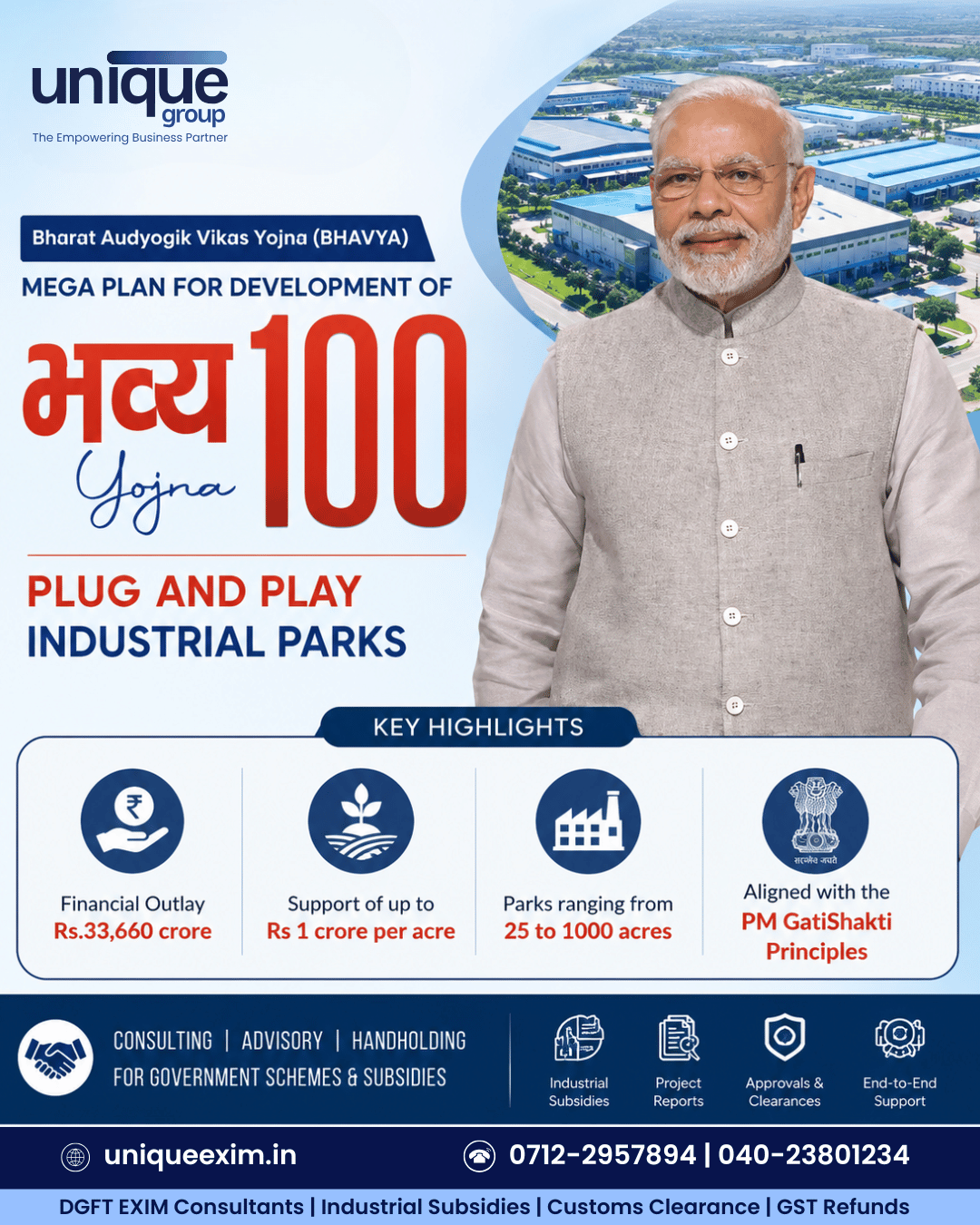
BHAVYA is a central sector scheme launched by DPIIT with INR 33,660 Crore outlay to develop 100 plug-and-play industrial parks across India between FY 2026-27 and FY 2031-32.
x
U
N
I
Q
U
E
G
R
O
U
P


Bharat Audyogik Vikas Yojna (BHAVYA): Complete Scheme Guide & Consultancy Services
India's industrial landscape is undergoing a structural shift toward plug-and-play manufacturing ecosystems designed for rapid investment grounding. Notified by the Department for Promotion of Industry and Internal Trade (DPIIT) on April 10, 2026, Bharat Audyogik Vikas Yojna (BHAVYA) is a Central Sector Scheme with a total outlay of INR 33,660 Crore. The scheme aims to establish 100 world-class, investment-ready industrial parks across India.
Whether you are a private real estate or infrastructure developer, a Central Public Sector Enterprise (CPSE), or a state nodal agency, BHAVYA involves complex governance structures such as Special Purpose Vehicle (SPV) formation, joint valuations, and tranche-linked milestone compliances. Unique Group provides end-to-end consulting to help structure, submit, execute, and monetize BHAVYA industrial park projects.
BHAVYA Scheme at a Glance
The BHAVYA scheme shifts India's industrial strategy from slow land allocation to plug-and-play manufacturing hubs integrated with PM GatiShakti principles. Key strategic benefits include:
- Capital support through central financial assistance by equity participation via National Industrial Corridor Development and Investment Trust (NICDIT).
- Single-window efficiency through delegated planning and development powers directly to project SPVs.
- Anchor investor flexibility, allowing private developers acting as anchor investors to self-allot up to 25% of developed land for their own units.
- Last-mile logistics support, with up to 25% of approved funding deployable toward external infrastructure such as highway links, power lines, and gas pipelines.
What is the BHAVYA Scheme?
Bharat Audyogik Vikas Yojna (BHAVYA) is a national policy initiative administered by DPIIT, with National Industrial Corridors Development Corporation (NICDC) acting as the Project Management Agency. It incentivizes creation of greenfield and unencumbered brownfield industrial parks equipped with physical, digital, social, and environmental infrastructure.
Objectives
- Enable investors to ground manufacturing investments without delay.
- Transform India into a globally competitive manufacturing hub through proximity to urban centers and multi-modal logistics facilities.
- Integrate domestic enterprises into Global Value Chains while deepening local supply chains.
Key Benefits and Assistance Pattern
Financial assistance under BHAVYA is disbursed as equity contribution, and debt where specifically approved, through NICDIT into the project SPV.
| Model Type | Subsidy / Financial Support Cap | Structural Conditions |
|---|---|---|
| Without Private Developer (State Government / CPSE Led) | Up to INR 1 Crore per acre | NICDIT equity participation capped at 50% of paid-up equity. Land transferred by State is treated as equity. |
| With Private Developer Collaboration (PPP Mode) | INR 50 Lakhs per acre or 50% of infrastructure cost, whichever is lower | Private developer equity must be at least 26%, contributed primarily via land valuation. NICDIT funding is capped at INR 50 Lakhs per acre. |
Crucial note: Under PPP projects, infrastructure cost covers core, value-added, and social infrastructure approved in the DPR. It excludes land costs, preliminary or pre-operative expenses, capitalized interest, and commercial built-up structures intended for sale or lease.
Eligible Infrastructure Components
- Core Infrastructure: Internal roads, pedestrian pathways, underground water, power and gas distribution, storm-water drains, streetlights, landscaping, CETP, WTP, STP, solid waste management, ICT/security networks, and fire safety systems.
- Value-Added Infrastructure: Built-to-Suit units, storage and warehousing, sector-specific R&D centers, testing labs, and renewable energy systems.
- Social Infrastructure: Worker housing, Common Facility Centres, daycare or health facilities, and skill development centers.
- External Infrastructure: Up to 25% of total approved funding can support last-mile roads to highways, ports or ICDs, power transmission lines, and dedicated water or gas supply lines.
Ineligible Components
- Land acquisition and land development costs.
- Commissioning fees, royalty, preliminary and pre-operative expenses.
- Capitalized interest, working capital, and transportation vehicles.
Scheme Eligibility Criteria
To enter the competitive challenge mode evaluation, proposals must meet mandatory baseline conditions:
Land Area Requirements
- Non-Hilly States: Minimum 100 acres of contiguous land, or up to two adjoining parcels of at least 100 acres each located within a 2 km radius.
- Hilly / Special Category States & UTs: Minimum 25 acres of contiguous land, applicable to Himachal Pradesh, Uttarakhand, North Eastern States, UTs, and states with population below 1 Crore.
- Mega Parks: Up to 20 parks nationwide may be developed between 500 and 1,000 acres.
Land Possession and Ownership
- At least 90% encumbrance-free land must be in possession at the time of application submission.
- Land ownership must be formally transferred to the SPV within 3 months of project sanction, extendable by 3 months by NLSC for genuine cases.
Private Developer Criteria for PPP Projects
- Positive net worth equal to at least 15% of total project cost, certified by a Chartered Accountant.
- Track record of developing industrial, real estate, or infrastructure projects with minimum developed area of 50 acres in a single project over the last 10 years.
- No debarment or blacklisting by Central or State governments within the past 3 years.
Check your BHAVYA eligibility today. Get an immediate eligibility evaluation, SPV structuring analysis, and financial grant projection from Unique Group's technical team.
Implementation via Special Purpose Vehicle (SPV)
Every BHAVYA project is executed through a Special Purpose Vehicle registered under the Companies Act, 2013.
- Delegation of Powers: The State Government must delegate statutory planning and development powers directly to the SPV for single-window clearances.
- Anchor Investor Self-Allotment: A private developer acting as an anchor investor may self-allot up to 25% of developed land for its own industrial unit. The remaining 75% must be allotted transparently to independent manufacturing units.
- O&M Corpus Fund: SPVs may allocate up to 5% of gross land allotment premium into a dedicated escrow account for operational deficits during the first 5 years.
- Developer Exit / Lock-In: Private developers are subject to a 5-year lock-in period from project completion and operationalization before equity transfer or disinvestment.
Phased Application Timeline
- Round 1 Window: June 1, 2026 to July 31, 2026.
- Round 2 Window: August 1, 2026 to September 30, 2026. Proposals not selected in Round 1 can re-apply with modifications.
- Execution Timeline: Core infrastructure development must be completed within 24 months of approval.
Financial Grant Calculation Examples
Example 1: State Nodal Agency / CPSE Model
- Land Area: 200 acres, 100% owned by State Agency.
- Approved DPR Infrastructure Cost: INR 180 Crore.
- Eligible Subsidy Cap: 200 acres x INR 1 Crore per acre = INR 200 Crore maximum funding limit.
- Grant Sanctioned: INR 180 Crore, funded as NICDIT equity subject to equity cap conditions.
Example 2: Private Developer Collaboration
- Land Area: 150 acres contributed by private developer.
- Approved DPR Infrastructure Cost: INR 120 Crore.
- Lower of 150 acres x INR 50 Lakhs per acre = INR 75 Crore, or 50% of INR 120 Crore = INR 60 Crore.
- Grant Sanctioned: INR 60 Crore.
Check how much grant you are eligible for under the BHAVYA scheme. Get a custom grant payout projection and SPV structuring strategy.
Tranche Release Conditions
- Tranche I - 40%: 30% on NLSC approval, 90% land transfer to SPV, delegation of single-window powers, water/power allocation, and Environmental Clearance. 10% on physical commencement of site work.
- Tranche II - 40%: Requires 75% utilization of Tranche I, proportionate physical progress, and formal land allotment to at least two manufacturing units with combined committed investment above INR 50 Crore, or INR 10 Crore in hilly states.
- Tranche III - 20%: 10% on 90% utilization of Tranches I and II, external infrastructure execution, and construction start by two units. Final 10% on Project Completion Certificate.
Documentation Required for Application
- Detailed Project Report prepared as per the standard Annexure II template.
- Land ownership deeds and title search reports proving 90% encumbrance-free status.
- Joint Valuation Committee reports signed by registered valuers.
- CA certificate verifying positive net worth above 15% of project cost.
- Completion certificates for more than 50 acres of developed real estate or industrial projects within the last 10 years.
- State Level Committee recommendation chaired by Chief Secretary.
- Proof of delegated planning powers, power tariff differential commitments, and environmental clearances.
Common Mistakes Applicants Make
- Submitting standard circle-rate valuations without the mandatory 3-member Joint Valuation Committee.
- Delaying the legal notification that delegates urban planning and sanctioning powers to the SPV, blocking Tranche I disbursement.
- Including land development or commercial building construction costs in the primary infrastructure cost budget.
- Registering standard SPV Articles of Association without mandatory DPIIT reserved matters and affirmative vote clauses.
Frequently Asked Questions
-
What is the BHAVYA Scheme?
-
Who is eligible to apply for BHAVYA?
State Industrial Development Corporations, CPSEs, and private infrastructure developers in partnership with State Nodal Agencies can apply.
-
How much subsidy is available under BHAVYA?
State or CPSE-led projects receive up to INR 1 Crore per acre. PPP projects receive up to INR 50 Lakhs per acre or 50% of eligible infrastructure cost, whichever is lower.
-
What is the minimum land required?
Non-hilly states require at least 100 contiguous acres. Hilly states, North Eastern states, UTs, and small states require at least 25 contiguous acres.
-
How are funds released?
Funding is released in three tranches: 40%, 40%, and 20%, linked to land transfer, clearances, utilization, allotment, construction milestones, and project completion.
Why Choose Unique Group?
Navigating government incentives requires more than administrative filing. It demands strategic alignment between corporate objectives and policy frameworks. Unique Group offers end-to-end consulting for the BHAVYA scheme.
- Proven track record with over INR 500 Crore in incentives delivered across 1,000+ industrial clients.
- Deep domain expertise across DGFT, MoFPI, state industrial policies, and infrastructure incentives.
- End-to-end handholding from feasibility studies to final Tranche III disbursement audits.
Need help preparing a BHAVYA proposal, DPR, SPV structure, or tranche compliance roadmap?