

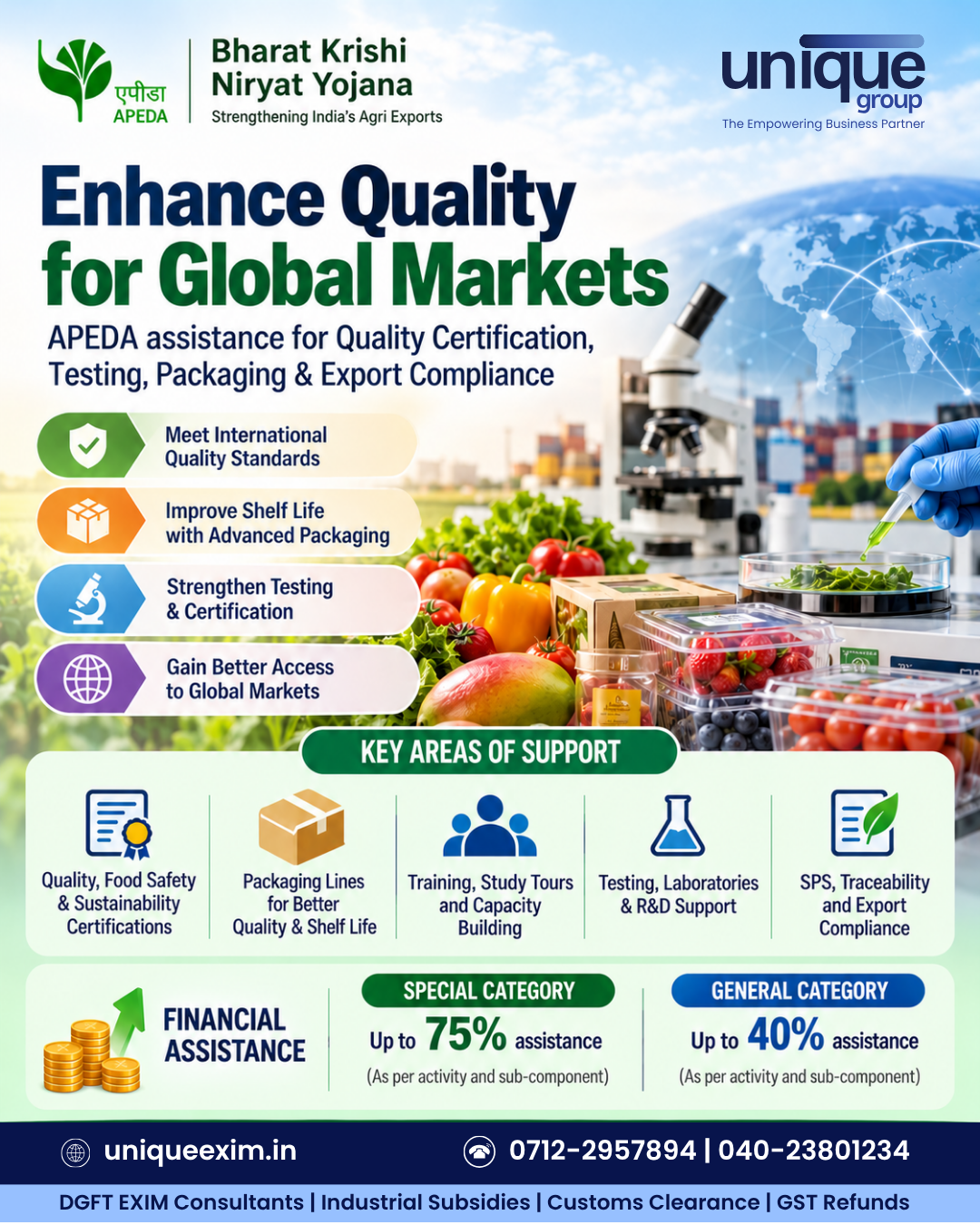
Bharat Krishi Niryat Yojana – Quality Development
APEDA Assistance for Quality Certification, Testing, Packaging & Export Compliance
International markets increasingly require agricultural and processed food products to meet specific food safety, quality, sustainability, residue, packaging and traceability requirements.
The Quality Development component under Bharat Krishi Niryat Yojana supports activities intended to strengthen compliance with international requirements and improve the quality and export readiness of Indian agricultural products.
The component covers certifications, international standards, packaging, testing, laboratories, product and technology development, Sanitary and Phytosanitary (SPS) interventions, startup support, traceability and capacity building.
Who can avail benefit under Quality component?
Eligibility depends on the particular activity and sub-component. The guidelines provide assistance to different categories of stakeholders. The assistance percentage and maximum ceiling may differ according to the beneficiary category, location, type of project and activity.
Special Category: Can receive enhanced assistance subject to the applicable conditions. These specified categories include FPOs, PACS, SC/ST, women beneficiaries and startups, as well as eligible beneficiaries from North - Eastern States, Ladakh, Andaman and Nicobar, Lakshadweep, Jammu and Kashmir.
General Category: Projects situated in other States or other class of beneficiaries, not specifically mentioned above
1. Implementation and certification of quality, sustainability and food safety management systems, standardization, harmonization with international standards for adoption of global standards
The assistance is provided to APEDA RCMC Holder and organic operator for obtaining food safety and quality certifications which are required as per requirements of importing countries or obtaining market access.
Pattern of Assistance
The assistance will be up to 50% of the total cost subject to a ceiling of Rs. 5 lakh per certification. The assistance will also be applicable for renewal of certifications
Eligible Certifications
- HACCP
- ISO 22000 / FSSC 22000
- IFS
- BRC
- SQF
- ISO 14001
- GAP
-
Sustainability certifications such as
- Rainforest Alliance
- Sedex Member
- Ethical Trade Audit (SMETA)
- FairTrade
- Demeter Biodynamic Certification
- Naturland
- Sustainable Agriculture (SA)
- Other eligible systems
2. Packaging Lines for Quality & Shelf Life
The scheme supports packaging systems designed to improve product quality and shelf life.
Pattern of Assistance
Special Category: up to 75%, subject to a ceiling of ₹10 lakh.
General Category: up to 40%, subject to a ceiling of ₹10 lakh.
Eligible Machinery & processes include:
- Controlled Atmosphere Packaging (CAP)
- Modified Atmosphere Packaging (MAP)
- Active packaging (Oxygen scavengers, Carbon dioxide absorbers/emitters, Ethylene absorbers, Humidity absorbers, antimicrobial preservative releasers, etc.)
- Antimicrobial agents
- Packaging systems
Important Conditions
- The applicant must have the food processing line already established.
- The applicant must have Food Safety Management System in place such as HACCP/ ISO 22000 certification granted by a certification body accredited by an accreditation body who is a member of International Accreditation Forum (IAF)
3. Strengthening Technical & Managerial Skills
3.1. Training & Study Tours
The scheme supports training and study tours in India and abroad for capacity building, stakeholder development and adoption of best practices. Assistance shall be given for short term executive courses (up to 1 month) relevant to agro industry, quality, marketing, management and doing business. Applicable only for courses offered by APEDA suggested institutes.
Pattern of Assistance:
- General Category: Up to 50% of travel cost and training fee, subject to ₹3 lakh per participant per year
- Special Category: Up to 75% subject to ₹3 lakh for specified beneficiary categories
3.2. Seminars, Workshops & Outreach
This component supports the organisation, sponsorship, and assistance of seminars, workshops, conferences, training-cum-outreach programmes, and similar awareness-building initiatives by APEDA.
Support under this component also includes the development and dissemination of knowledge and communication materials such as manuals, brochures, guidelines, advisory notes, and other reference documents, wherever required. These activities will facilitate effective information dissemination, capacity enhancement, and stakeholder engagement.
Pattern of Assistance:
- General Category: Up to 50%, subject to ₹5 lakh per beneficiary per event
- Special Category: Up to 75% subject to ₹3 lakh per beneficiary per event
4. Testing of Water, Soil & Contaminants
The assistance is provided for testing of parameters for products where testing is mandatory as per the importing country’s requirements or under food safety-based monitoring systems implemented by APEDA, for which notifications have been issued by the Government of India time to time.
Eligible testing can include:
- Water
- Soil
- Pesticide residues
- Veterinary drugs
- Hormones
- Toxins
- Heavy metals
- Microbial counts
- Other specified contaminants
Pattern of Assistance:
- For APEDA registered exporters and NPOP organic Operators: Up to 50 of the total cost subject to ₹5,000 per sample, with an overall ceiling of ₹20 lakh per beneficiary during the plan period
5. New Plant, Seed & Germplasm Varieties
This component supports introduction of new plant, seed and germplasm varieties for export-oriented production or varieties suitable for processing.
Pattern of Assistance:
- Govt. / ICAR: Up to 90% of Imported plant material
- APEDA exporters: Up to 60% of Imported plant material subject to ceiling of ₹50 lakh per beneficiary
The beneficiary remains responsible for applicable selection, import clearance and royalty-related requirements.
6. Laboratory & Technology Support
6.1. APEDA listed labs for upgradation
The assistance shall be provided to APEDA recognised laboratory for purchase of high-end analytical equipment and Certified Reference Material (CRM) required for the detection and quantification of molecules that are part of emerging requirements in importing countries thereby ensuring compliance with stringent international standards and minimizing the risk of rejection in importing countries.
Pattern of Assistance:
- General Category: Up to 50%, subject to ceiling of ₹200 lakh per beneficiary
- Special Category: Up to 75%, subject to ceiling of ₹200 lakh per beneficiary
Eligibility Conditions:
- The laboratory shall be a APEDA recognised laboratory and having valid ISO 17025 accreditation granted
- The laboratory shall have either product recognition granted by APEDA or qualify the PT programme conducted by the NRL of APEDA
- Assistance shall not be applicable for in process quality control equipment, consumables, glassware, computers, general refrigerators, air conditioners or laboratory furniture and civil works
6.2. In-house laboratory equipment
This component supports APEDA‑registered exporters and operators certified under NPOP in upgrading in‑house laboratory facilities through procurement of essential testing, analysis, and quality‑control equipment. The objective is to strengthen internal quality assurance systems, enable routine and timely testing of products, and ensure conformity with prescribed domestic and international food safety and quality standards.
Pattern of Assistance:
- General Category: Up to 50%, subject to ceiling of ₹100 lakh per beneficiary
- Special Category: Up to 75%, subject to ceiling of ₹100 lakh per beneficiary
Eligibility Conditions:
- The assistance shall be availed by the inhouse laboratory of APEDA registered exporters and operators certified under NPOP.
- Assistance shall be granted for APEDA recommended lab equipment
- Assistance shall not be applicable for in process quality control equipment, consumables, glassware, computers, general refrigerators, air conditioners or laboratory furniture and civil works
7. Aatam Nirbhar Bharat
7.1 Innovative Infrastructure & Quality Improvement
This component encourages and supports innovative concepts, technologies, and solutions aimed at strengthening infrastructure and enhancing quality in the agricultural and processed food exports. It promotes the development, piloting, and adoption of new approaches that can address existing bottlenecks, improve efficiency, reduce losses, and elevate product standards in line with domestic and international market requirements.
Pattern of Assistance:
The selected entity can receive assistance of up to ₹100 lakh
Eligibility Conditions:
- Applicant must be an APEDA‑ RCMC Holder(manufacturer, producer) at the time of application.
- Proposed idea/technology must demonstrate clear relevance to APEDA scheduled products.
- The innovation should address a specific bottleneck in infrastructure, quality, or export readiness.
- The proposal must demonstrate novelty in process, product, technology, or delivery mechanism. And must provide clear articulation of how the idea differs from existing solutions in the market. The solution must have potential for scalability and adaptability.
- At the time of application, beneficiary must submit technical specifications, design documents, prototypes, or proof‑of‑concept, as applicable.
- Collaboration may be allowed with reputed institutions, R&D organisations, or technology partners and must be documented through MoUs or letters of support.
- In case of collaboration, roles and responsibilities of each collaborating entity must be clearly defined.
7.2 Enhance quality of the produce to meet the SPS Requirements of Importing Countries
This component supports targeted interventions aimed at improving the quality of agricultural and processed food products to meet the Sanitary and Phytosanitary (SPS) requirements of importing countries.
Activities under this support may address specific challenges involving:
- Pest management
- Disease management
- Residue reduction
- Special treatments
- Handling and hygiene
- Product safety and compliance
Pattern of Assistance:
50% of total cost subject to ceiling of ₹25 lakh per beneficiary.
Eligibility Conditions:
- Activities proposed under this sub-component must specifically target SPS requirements of identified importing countries.
- At the time of application, the beneficiary must submit a detailed proposal outlining the SPS challenge, target market, and the specific intervention required. Provide, supporting documents such as lab reports, rejection notices, pest incidence data, or import-country advisories.
- Each application must include details of expected outcomes such as reduced contamination, improved hygiene, residue reduction, or pest control.
8. Support for Agri & Food Startups
8.1 Support to startups for infrastructure and quality improvement
To enable agri-food startups to build export-compliant, market-aligned infrastructure and focus on improving export-grade output, reducing rejection, and enhancing realisation.
Pattern of Assistance:
50% of total cost subject to ceiling of ₹100 lakh per beneficiary.
Eligibility Conditions:
- Component shall be restricted to APEDA’s BHARATI registered agri-food startups in building export-ready infrastructure and quality systems that enhance compliance with international requirements.
-
Eligible interventions under this component shall include the following categories
- Infrastructure & Quality Enablement including integrated packhouses and primary processing facilities at farm-gate/cluster level, cold chain infrastructure, export-oriented packaging, minimal processing facilities, implementation and certification of Food Safety Management Systems (HACCP, BRC, ISO, etc.), implementation of sustainability and ethical trade certifications etc.
- Technology Enablement including farm-to-fork traceability systems (QR-based, blockchainenabled), digital farm records and compliance tracking (GAP, residue monitoring), AI/ML-based grading, sorting, and shelf-life prediction, ERP and batch-level traceability systems for export documentation and inventory, etc.
- Export Value Chain Solutions including technologies addressing post-harvest losses, quality standardisation, and aggregation challenges, supply chain optimisation platforms including logistics, demand aggregation, and buyer linkage, quality assessment and grading technologies (including non-invasive testing solutions), packaging innovation and shelf-life extension solutions deployable across exporters
- Novel solutions from SPS & Compliance-Focused Startups including rapid residue detection and testing technologies, pest and disease detection, monitoring, and mitigation systems, traceability systems linked to SPS compliance and certification, export compliance automation tools (phytosanitary certification, documentation systems), bio-safe treatments, non-chemical interventions, and post-harvest compliance protocols etc.
- All applicant startups shall be required to submit detailed three-year export or deployment projections, including target markets and buyer segments, expected volumes, value realisation, technology adoption metrics, and clear linkage between proposed intervention and export outcomes.
- Post-sanction, beneficiaries shall be subject to structured monitoring and evaluation including export performance, market expansion, reduction in rejection rates, reduction in compliance gaps, adoption of technology created improvement in value realisation and competitiveness as applicable.
9. High precision technology for quality processing
To ensure traceability of produce at farm level and to comply with the requirements of importing countries.
Pattern of Assistance:
50% of total cost subject to ceiling of ₹20 lakh per beneficiary.
Eligibility Conditions:
- This component shall be restricted to startups as defined under general conditions.
- This shall include hardware such as scanners, RFID systems, IoT devices, handheld data capture devices, servers, traceability platforms, ERP modules, blockchain based systems, customisation of software, trainings etc.
10. Capacity Building & Export Startup Internationalisation
The Quality Development component also provides for:
- Training of Trainers
- Structured programmes for export startups
- Grant Management System
- Technical assistance support
Pattern of Assistance:
The Training of Trainers programme can receive 50% assistance subject to ₹5 lakh per beneficiary per year
Who Should Consider Quality Development Assistance?
This component may be relevant to:
- Food manufacturers
- Agricultural exporters
- Organic operators
- FPOs
- Export-oriented startups
- Laboratories
- Businesses requiring international certifications
- Exporters facing residue/SPS requirements
- Businesses upgrading packaging
- Organisations developing export technologies
Why Quality Development Matters for Agricultural Exports
Meeting the production requirement alone may not be sufficient for accessing international markets. Exporters may also need to demonstrate compliance with food-safety, quality, residue, packaging, sustainability and SPS requirements.
The Quality Development component is intended to strengthen these capabilities across the export value chain.
Need Help Identifying the Right Quality Development Provision?
The applicable assistance depends on the specific certification, testing activity, equipment, technology, beneficiary category and other conditions.
Unique Group can help exporters assess the relevant APEDA Quality Development provision and understand the applicable eligibility, assistance ceiling and documentation requirements.