Yes. DGFT allows amendments to an EPCG Licence after issuance, subject to applicable regulations and timelines.
x
U
N
I
Q
U
E
G
R
O
U
P


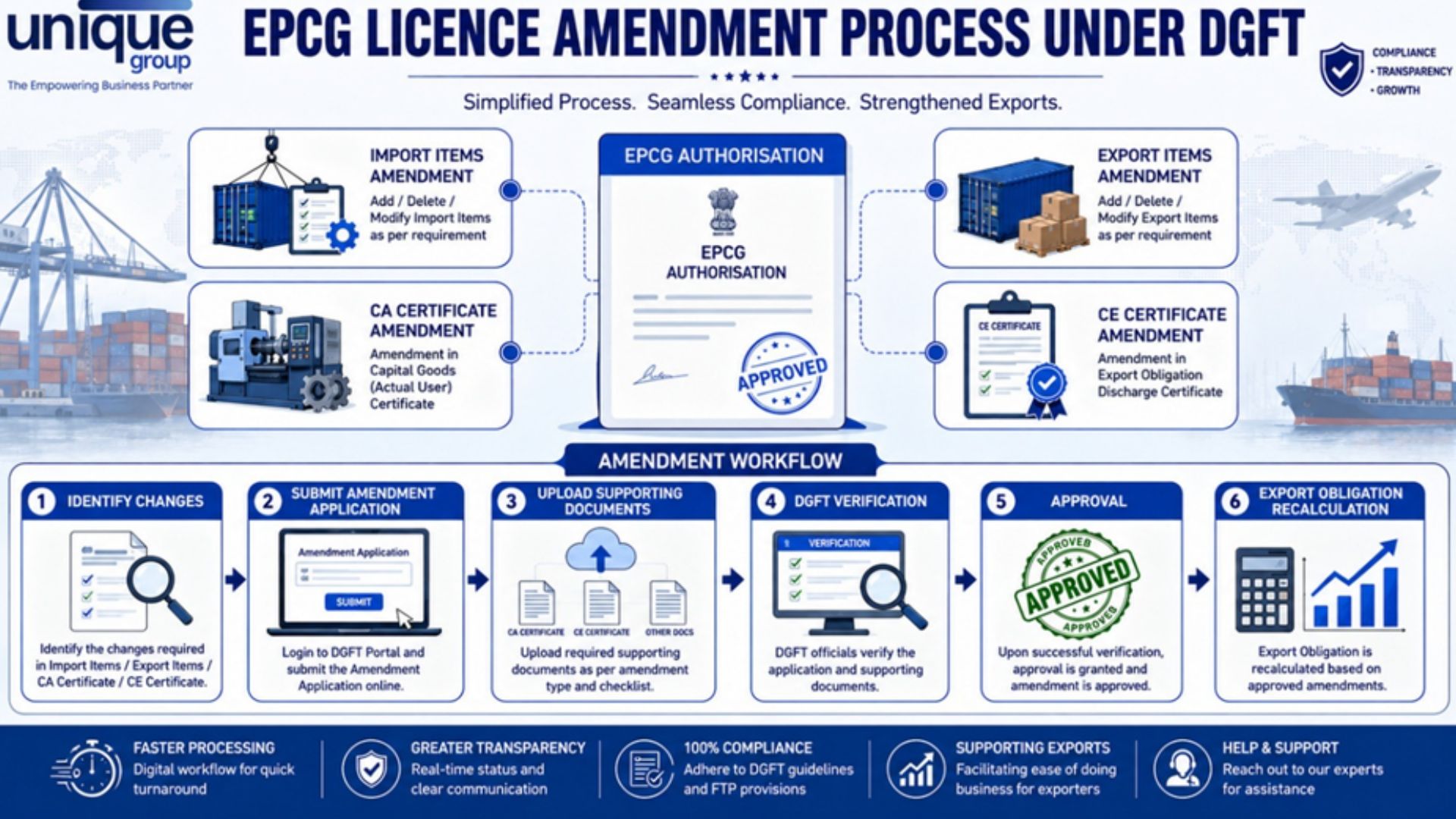
Amendment of EPCG Licence: Complete Guide to EPCG Licence Modification Under DGFT
The Amendment of EPCG Licence is an essential provision under the Export Promotion Capital Goods (EPCG) Scheme, allowing exporters to rectify errors and update information after the issuance of an EPCG Authorisation. Businesses often discover inaccuracies in import details, export commitments, or supporting documents after obtaining the licence. To address these situations, the Directorate General of Foreign Trade (DGFT) permits amendments within the prescribed timeframe.
An EPCG Licence is a valuable authorization that enables businesses to import capital goods at 0% customs duty rates in exchange for fulfilling specified export obligations. Since the export obligation is directly linked to the information provided in the licence application, maintaining accurate records is critical. Any discrepancy in import values, export products, or certification details can lead to compliance challenges.
The EPCG amendment facility ensures that exporters can correct such issues without applying for a fresh licence. By submitting a formal amendment request, businesses can update the details of their authorisation and continue to avail EPCG benefits while remaining compliant with DGFT regulations.
What is an EPCG Licence Amendment?
An EPCG Licence Amendment refers to the process of modifying information contained in an already issued EPCG Authorisation. The facility is intended to help exporters correct errors, update licence particulars, and maintain consistency between their business operations and the conditions specified in the licence.
DGFT allows amendments to be filed within 24 months (2 years) from the date of licence issuance. During this period, applicants can request changes to import items, export items, CA certificates, CE certificates, and other approved particulars as permitted under applicable regulations.
The amendment process provides flexibility to exporters who may have entered incorrect information during the application stage or whose business requirements have evolved after licence issuance. Instead of cancelling and reapplying for a new licence, businesses can utilize the amendment mechanism to make necessary corrections efficiently.
Amendments Allowed Under EPCG Licence
DGFT permits several types of amendments under the EPCG Scheme. These modifications help ensure that licence details accurately reflect actual business requirements and export commitments.
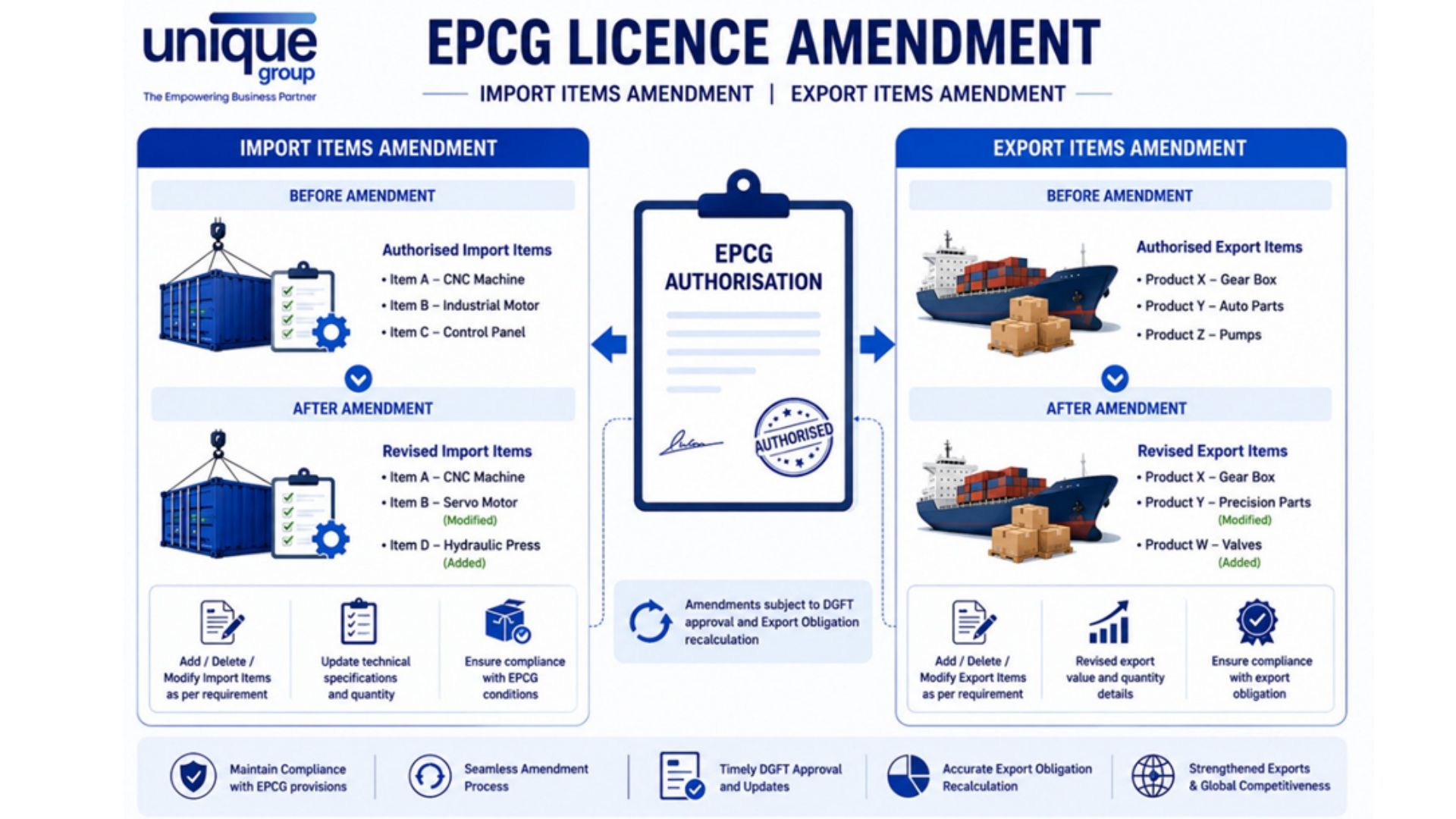
Amendment of Import Items
Import item amendments are among the most common requests filed under the EPCG Scheme. Businesses may need to update product descriptions, technical specifications, quantities, or values of capital goods approved under the licence.
Examples include:
- Correction of machinery descriptions
- Changes in technical specifications
- Revision of CIF value
- Addition or deletion of approved capital goods
- Rectification of clerical mistakes
Accurate import item details are crucial because they directly impact the export obligation calculation and overall EPCG compliance.
Amendment of Export Items
Exporters can also request modifications to the export products mentioned in their EPCG Licence. Such amendments may become necessary due to changes in product lines, export strategies, or errors in the original application.
Common export item amendments include:
- Product description corrections
- Export category modifications
- Changes in export specifications
- Updates to export commitments
Maintaining accurate export item details ensures proper monitoring and fulfillment of export obligations.
EPCG Licence Amendment Procedure
The EPCG amendment process is conducted through the DGFT portal and requires careful preparation of documents and supporting evidence.
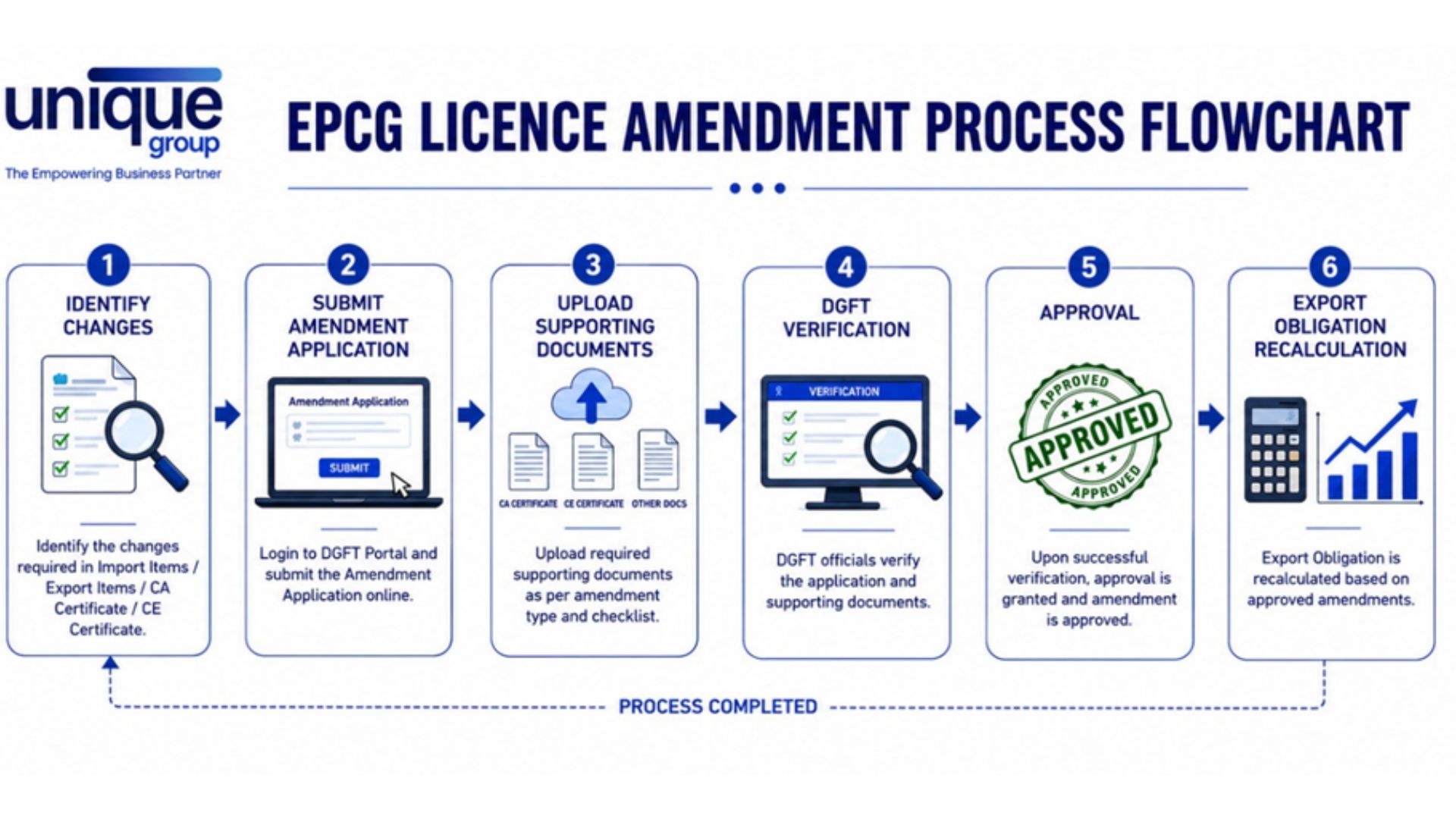
The typical process involves the following steps:
Step 1: Identify Required Changes
Review the existing EPCG Licence and determine the exact information that requires amendment.
Step 2: Gather Supporting Documents
Prepare revised certificates, invoices, technical specifications, and any other supporting documentation necessary for the amendment request.
Step 3: Submit Amendment Application
File the amendment application through the DGFT online portal with accurate details and explanations.
Step 4: Upload Revised Certificates
Where applicable, upload updated CA certificates, CE certificates, valuation reports, or technical documentation.
Step 5: Submit Declaration
Applicants are generally required to submit a fresh declaration confirming the accuracy of revised information.
Step 6: Pay Amendment Fee
The prescribed government fee must be paid during the application process.
Step 7: DGFT Review and Approval
The concerned licensing authority reviews the application and supporting documents before issuing approval.
Upon approval, the amended EPCG Licence becomes effective and supersedes the previous information.
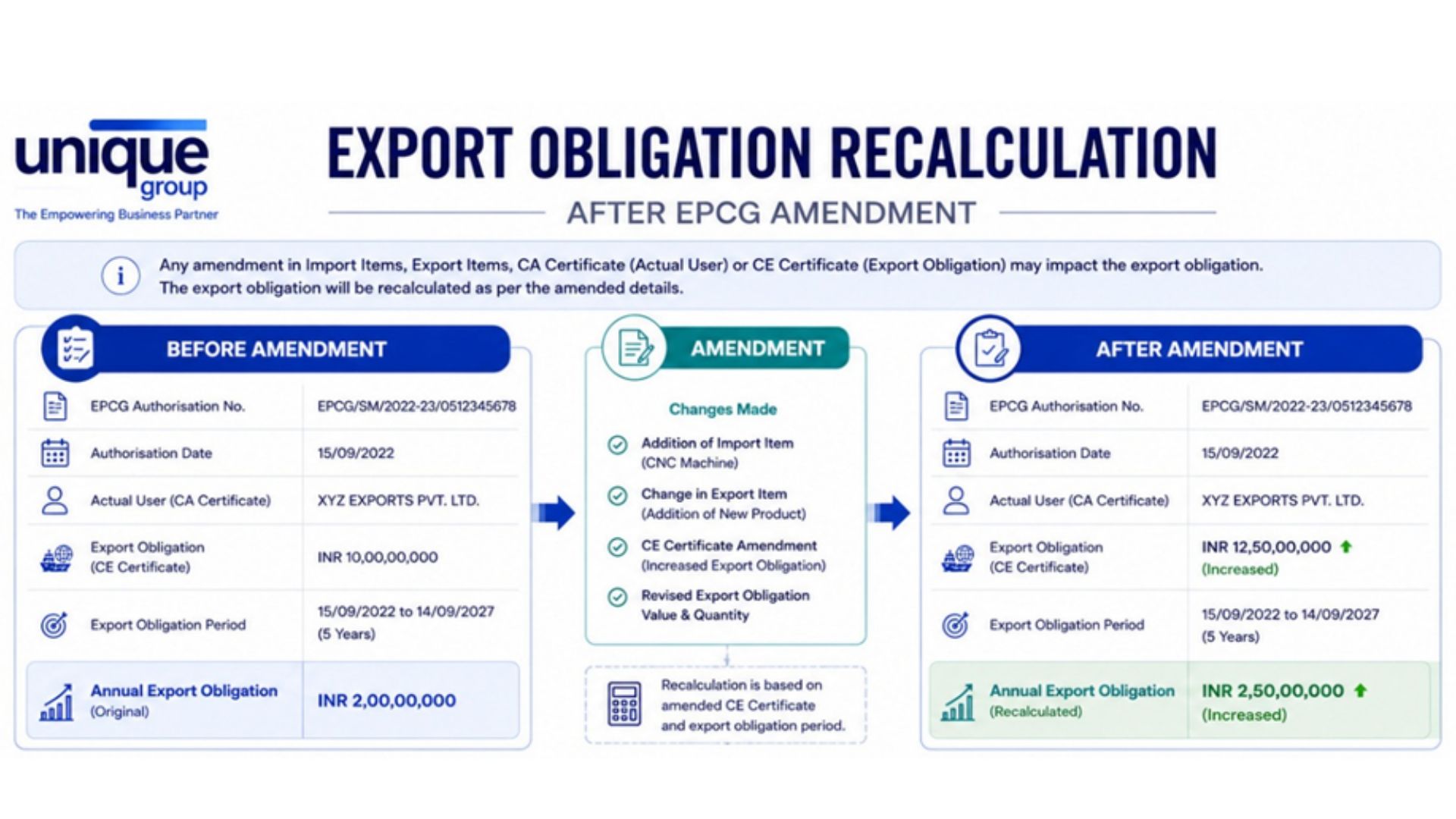
Recalculation of Export Obligation After Amendment
One of the most important consequences of an EPCG Licence Amendment is the recalculation of export obligation.
Under the EPCG Scheme, export obligations are determined based on the value of imported capital goods and the terms specified in the authorisation. When amendments affect these factors, DGFT recalculates the export obligation using the revised information.
After approval, exporters must comply with the revised export obligation requirements. Failure to do so may result in penalties or difficulties during licence closure.
Therefore, applicants should carefully assess the implications of any amendment before submission.
Documents Required for EPCG Licence Modification
The documentation requirements for EPCG amendments vary depending on the nature of the request. However, most applications require a standard set of supporting records.
Commonly required documents include:
- Existing EPCG Licence
- Amendment request letter
- Revised CA Certificate
- Revised CE Certificate
- Commercial invoices
- Technical specifications
- Product catalogues
- Import documentation
- Export product details
- Justification statement
- Additional documents requested by DGFT
Providing complete and accurate documentation significantly improves processing efficiency and reduces approval delays.
Applicants should verify that all supporting documents are consistent with the information contained in the amendment application.
Frequently Asked Questions (FAQs)
-
Can an EPCG Licence be amended after issuance?
-
What is the time limit for EPCG Licence Amendment?
Generally, amendments can be requested within 24 months from the date of licence issuance.
-
Which details can be amended in an EPCG Licence?
Import items, export items, CA certificates, CE certificates, valuation details, and other approved particulars may be amended depending on eligibility.
-
Does an EPCG amendment affect export obligation?
Yes. Approved amendments may result in recalculation of export obligation based on revised figures.
-
Is a fee required for EPCG amendment?
Yes. Applicants are generally required to pay the prescribed amendment fee while filing the request.
-
Can CA and CE certificates be modified?
Yes. DGFT permits amendments relating to CA and CE certificates when justified by supporting documentation.
-
How long does the amendment process take?
Processing time varies depending on the complexity of the amendment and the completeness of supporting documents.
