

Import Process under EPCG Scheme & Installation Certificate
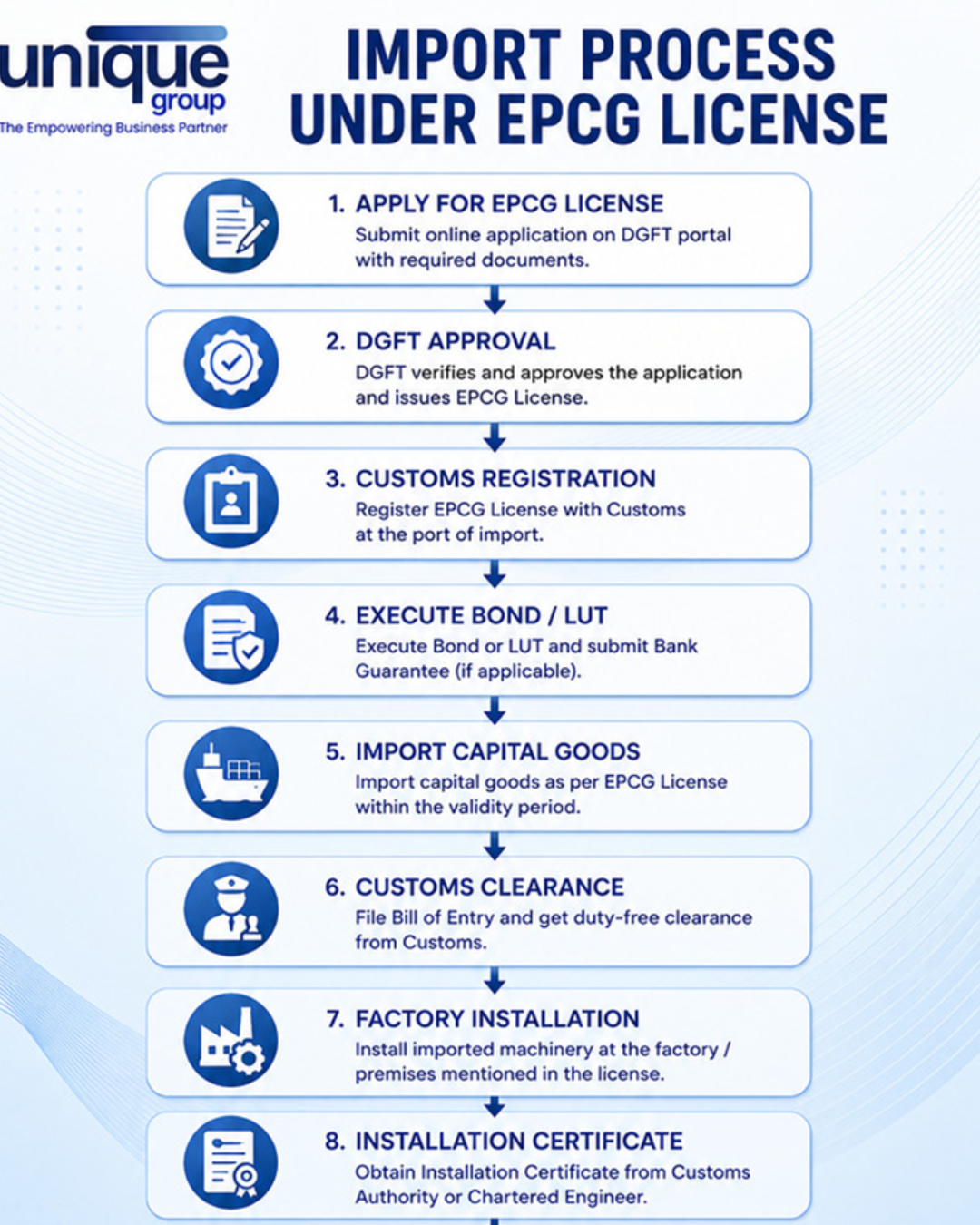
Import Process under EPCG Scheme
The Export Promotion Capital Goods (EPCG) Scheme is one of the most beneficial export promotion initiatives introduced by the Directorate General of Foreign Trade (DGFT). The scheme enables eligible exporters to import capital goods at zero customs duty, helping businesses reduce project costs, modernize production facilities, and improve export competitiveness.
Understanding the import process under the EPCG License is crucial for ensuring compliance with DGFT regulations and successful fulfillment of export obligations.
Step 1: Obtain EPCG Authorization
The first step in the EPCG import process is obtaining an EPCG Authorization from DGFT through the online portal.
The EPCG authorization specifies:
- Import items approved for import
- CIF value of capital goods
- Export products or services
- Export obligation to be fulfilled
- Port of registration for customs clearance
Importers should carefully review all details before proceeding with imports under the EPCG Scheme.
Step 2: Register EPCG Authorization with Customs
After receiving the EPCG License, the authorization holder must register the authorization with the customs authority at the port of import mentioned in the EPCG authorization.
The importer is generally required to execute:
- General Bond
- Letter of Undertaking (LUT)
- Bank Guarantee (where applicable)
Certain categories of exporters may be eligible for exemption from furnishing a bank guarantee based on customs and DGFT guidelines.
Proper registration ensures that duty exemption benefits under the EPCG Scheme can be availed at the time of import.
Step 3: Import Capital Goods under EPCG License
Capital goods should generally be imported within 24 months from the date of issuance of the EPCG License. Revalidation of the import validity period is generally not permitted, making timely imports essential.
Before filing the Bill of Entry (BE) with Customs, the importer should verify that the following details exactly match the EPCG authorization:
- Import Item Description
- ITC (HS) Code
- Quantity
- Unit of Measurement (UOM)
- CIF Value (US$ / INR)
- Commercial Invoice Details
- Packing List and Shipping Documents
Accurate documentation helps avoid customs objections, delays, and compliance issues under the EPCG Scheme.
Step 4: Customs Clearance and Duty-Free Import
One of the major benefits of the EPCG Scheme is the ability to import eligible capital goods without payment of customs duty.
After successful verification, Customs grants duty-free clearance of the imported machinery. The customs officer records and endorses:
- Bill of Entry
- Import details
- Duty exemption benefits
- EPCG authorization references
Proper EPCG endorsements on the Bill of Entry are critical for future export obligation monitoring and EPCG redemption.
Step 5: Installation of Capital Goods
After customs clearance, the imported machinery must be transported to the factory, production unit, or service facility specified in the EPCG authorization.
As per EPCG compliance requirements, machinery imported under the EPCG License should generally be installed within six months from the date of import (Bill of Entry Date).
The installation process should be properly documented because it forms the basis for obtaining the mandatory Installation Certificate.
Indigenous Procurement under EPCG Scheme
Apart from direct imports, the EPCG Scheme also permits procurement of capital goods from domestic manufacturers through the Invalidation Mechanism.
This facility supports the "Make in India" initiative while allowing exporters to avail EPCG benefits.
Procurement Process after Invalidation
After receiving the invalidation letter from DGFT, the authorization holder can start procuring machinery from eligible Indian manufacturers.
Important Requirements
- Capital goods must be manufactured in India.
- Tax invoice must mention EPCG License Number and Date.
- Machinery should be installed at the approved factory premises.
- Supplies should be reported as Deemed Exports by the supplier.
GST Compliance for Indigenous Procurement
The supplier of machinery must file GST returns under the Deemed Export Category for supplies made against EPCG authorization.
The authorization holder should:
- Retain GST input tax credit related to the machinery.
- Avoid reversing GST input credit if planning to claim a refund.
- Maintain complete documentation for refund processing.
The supplier should also provide a disclaimer certificate wherever applicable.
Generally, GST refunds are credited to the authorization holder within 2 to 3 months, subject to successful verification by the authorities.
Installation Certificate under EPCG Scheme
The Installation Certificate is one of the most important compliance requirements under the EPCG Scheme.
It serves as proof that the imported or domestically procured capital goods have been installed and put into use at the approved factory or business premises.
The certificate verifies:
- Location of installation
- Description of machinery
- Quantity installed
- Date of installation
- Operational status of equipment
The Installation Certificate plays a vital role in future EPCG compliance and export obligation monitoring.
Who Can Issue the Installation Certificate?
The Installation Certificate may be issued by:
1. Jurisdictional Customs Authority
The customs authority may physically inspect the machinery and certify that the capital goods have been installed at the approved premises.
2. Independent Chartered Engineer
A qualified and authorized Chartered Engineer can also issue the Installation Certificate after verifying:
- Machine specifications
- Installation status
- Serial numbers
- Production capability
- Operational readiness
Both methods are generally accepted under EPCG compliance requirements.
Timeline for Submission of Installation Certificate
The Installation Certificate can be uploaded by the authorization holder within three years from the date of completion of import of the capital goods.
In case of import of spares, the Installation Certificate must be uploaded within three years from the date of import.
Timely submission is essential for avoiding compliance issues and future disputes during EPCG redemption.
Documents Required for Installation Certificate
The following documents are generally required:
- EPCG Authorization Copy
- Bill of Entry
- Commercial Invoice
- Packing List
- Freight Documents
- Machinery Photographs
- Factory Address Proof
- GST Registration Certificate
- Chartered Engineer Report (if applicable)
Maintaining proper documentation helps ensure smooth compliance and future verification by DGFT and Customs authorities.
Consequences of Non-Submission of Installation Certificate
Failure to submit the Installation Certificate within the prescribed time may result in:
- Compliance notices from DGFT
- Customs duty demand
- Interest liabilities
- Delays in export obligation discharge
- Difficulties in obtaining future EPCG authorizations
- Challenges during EODC issuance
Therefore, businesses should ensure timely installation and submission of the Installation Certificate to maintain EPCG compliance.
